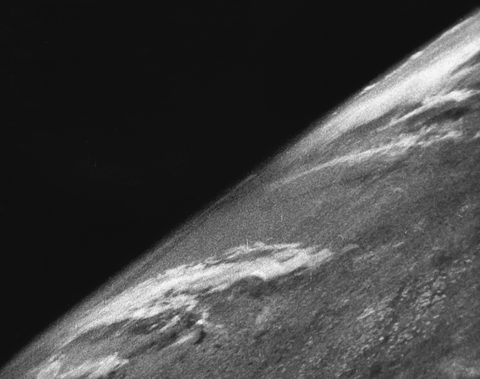
First photograph from space
Johns Hopkins APL / White Sands, 1946
A grainy curve. The first camera that came back from above the air. Nobody in the picture is in space. The camera went alone. It survived long enough to say the horizon is round.
About this work
This grainy frame is one of the first photographs ever taken from space. It was made on October 24, 1946, by a camera riding V-2 rocket No. 13, launched from White Sands Missile Range in New Mexico. The rocket reached a maximum altitude of 65 miles (105 km), about five times higher than any photograph had been taken before, and its DeVry 35 mm black-and-white motion picture camera exposed a frame every second and a half. What it recorded was the curve of the Earth below a black sky. The flight was part of the U.S. Army's Hermes program, which had been running since 1944, and the rocket was assembled and launched by the General Electric company from a mix of captured German components and re-manufactured parts. The picture is credited to White Sands Missile Range and the Applied Physics Laboratory.
Sources: Wikimedia Commons · Wikipedia: V-2 No. 13
Print facts
- Native resolution
- 2,048 × 1,619 px
- Sharp at 150 ppi up to
- 13 × 10 in
- Sizes
- Small (20 × 16 in) · $100 · 101 ppi
- Price includes
- Frame and US shipping · 14–21 days · 30-day returns
FAQ
Where can I buy a framed print of First photograph from space?
Here. First photograph from space is available as a framed print in one size: Small (20 × 16 in) for $100. Prices include the frame and US shipping; delivery takes 14–21 days, with 30-day returns.
What size works best for First photograph from space?
The file is 2,048 × 1,619 px, and it is offered in one size, Small (20 × 16 in), which prints at 101 ppi: fine from a few feet away, softer up close.
Is it legal to print First photograph from space?
Yes. The photograph was made on a U.S. Army V-2 flight at White Sands Missile Range and is published as a work of the U.S. Army, which makes it a U.S. government work in the public domain. The picture is credited to White Sands Missile Range and the Applied Physics Laboratory.