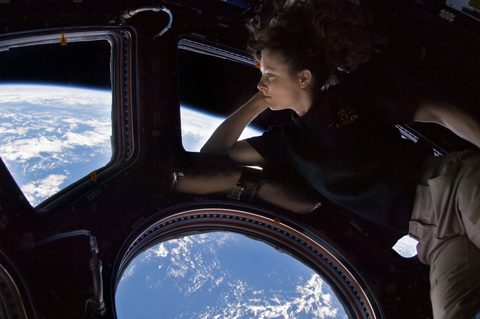
Tracy Caldwell Dyson in the Cupola
NASA / Expedition 24, 2010
A woman in a bay window, and the window is the whole Earth. She can see weather that will never reach her. The glass is the only reason this is a room and not a fall.
About this work
NASA astronaut Tracy Caldwell Dyson looks out at Earth through the windows of the Cupola on the International Space Station in this self-portrait from 11 September 2010, during Expedition 24. The Cupola is the station's observation module, a dome of windows facing Earth, and the planet fills the glass in front of her.
The Cupola was added to the station in early 2010, and it gave crews a panoramic view of Earth and the space around the station. Caldwell Dyson spent several months on the station during this expedition.
The picture combines the human scale of a person at a window with the enormous view beyond, which makes it one of the most relatable images from the space station. The scan is 4288 × 2848 pixels in landscape format, good for medium and large prints. It suits a study, a home office or a reading nook, and is an inspiring gift for young people interested in science. Image: NASA/Tracy Caldwell Dyson.
Sources: Wikimedia Commons
FAQ
Where can I buy a framed print of Tracy Caldwell Dyson in the Cupola?
Here. Tracy Caldwell Dyson in the Cupola is available as a framed print in three sizes: Small (20 × 13 in) for $195, Medium (24 × 16 in) for $295 and Large (36 × 24 in) for $395. Prices include the frame and US shipping; delivery takes 14–21 days, with 30-day returns.
What size works best for Tracy Caldwell Dyson in the Cupola?
The file is 4,288 × 2,848 px. Medium (24 × 16 in) is the largest size that prints at 150 ppi or more (178 ppi), the sharpest choice for close viewing; Large (36 × 24 in) prints at 119 ppi, fine from a few feet away but softer up close.
Is it legal to print Tracy Caldwell Dyson in the Cupola?
Yes. NASA made this photograph, and NASA material is not protected by copyright in the United States unless noted, so it can be printed and sold. A print does not imply NASA endorsement, and NASA's logos and insignia are not covered.

















