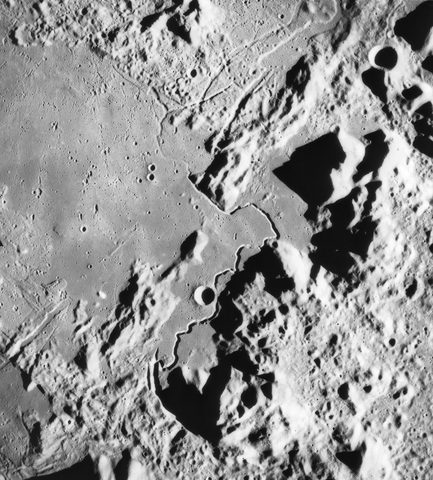
Hadley-Apennine from Apollo 15
NASA / Apollo 15 crew, 1971
Mountains without air, without color, without sound. The valley is a place they named so they could talk about it. The Moon does not use the name.
About this work
This near-vertical photograph of the Hadley-Apennine region of the Moon was taken by the Fairchild metric mapping camera in the scientific instrument bay of the Apollo 15 command and service modules, in lunar orbit. It was made on 30 July 1971, shortly after the lunar module had touched down.
Hadley Rille, a long winding channel, meanders through the lower center. The Apennine Mountains dominate the picture. The landing site lies on the east side of a bend in the rille known as the "chicken beak", near the center, and the crater Hadley C sits near the center at the rille's west edge. The smooth dark area is the Marsh of Decay. North is at the top when the dark mare is on the left.
The mapping camera was one of eight lunar orbital science experiments carried in the bay. The result is an austere black-and-white map of mountains and plains. The scan is 3274 × 3633 pixels, good for medium prints. It suits a study or a library, and is a fine gift for geologists and astronomers. Image: NASA.
Sources: NASA Image and Video Library
FAQ
Where can I buy a framed print of Hadley-Apennine from Apollo 15?
Here. Hadley-Apennine from Apollo 15 is available as a framed print in three sizes: Small (18 × 20 in) for $195, Medium (22 × 24 in) for $295 and Large (32 × 36 in) for $395. Prices include the frame and US shipping; delivery takes 14–21 days, with 30-day returns.
What size works best for Hadley-Apennine from Apollo 15?
The file is 3,274 × 3,633 px. Small (18 × 20 in) is the largest size that prints at 150 ppi or more (182 ppi), the sharpest choice for close viewing; Large (32 × 36 in) prints at 101 ppi, fine from a few feet away but softer up close.
Is it legal to print Hadley-Apennine from Apollo 15?
Yes. NASA made this photograph, and NASA material is not protected by copyright in the United States unless noted, so it can be printed and sold. A print does not imply NASA endorsement, and NASA's logos and insignia are not covered.
















