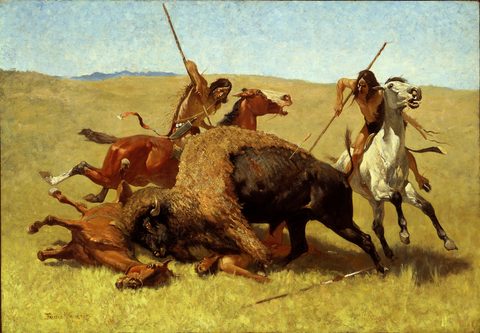
The Buffalo Hunt
Frederic Remington, 1890
A rider brings his lance to bear as a great bull buffalo turns on the plains.
About this work
A Native American rider leans forward with his lance as a huge bull buffalo wheels to face him on the open plains in The Buffalo Hunt, painted by Frederic Remington in 1890. It is in the Whitney Western Art Museum at the Buffalo Bill Center of the West in Cody, Wyoming. The painting records a way of life that had already gone when Remington painted it. Tens of millions of American bison once roamed the Great Plains, and for the Plains peoples the buffalo provided food, shelter, clothing and tools. Commercial hide hunting and the spread of railroads in the 1870s and 1880s drove the herds almost to extinction, and by the end of the 1880s only a few hundred wild bison were left. Conservation efforts since then have brought the species back from the brink. Remington, born in Canton, New York, in 1861, went west as a young man and made his name drawing cavalry, cowboys and Native Americans for Harper's Weekly and other magazines. By 1890 he was the leading illustrator of the West, and he went on to make celebrated bronze sculptures. He died in 1909.
Sources: Wikimedia Commons · Wikipedia: Frederic Remington · Wikipedia: American bison
FAQ
Where can I buy a framed print of The Buffalo Hunt?
Here. The Buffalo Hunt is available as a framed print in three sizes: Small (20 × 14 in) for $195, Medium (24 × 17 in) for $295 and Large (36 × 25 in) for $395. Prices include the frame and US shipping; delivery takes 14–21 days, with 30-day returns.
What size works best for The Buffalo Hunt?
The file is 4,597 × 3,191 px. Medium (24 × 17 in) is the largest size that prints at 150 ppi or more (188 ppi), the sharpest choice for close viewing; Large (36 × 25 in) prints at 128 ppi, fine from a few feet away but softer up close.
Is it legal to print The Buffalo Hunt?
Yes. The Buffalo Hunt is in the public domain: Frederic Remington died in 1909, so its copyright expired long ago. In the United States a faithful photograph of a public-domain painting does not create a new copyright (Bridgeman v. Corel, 1999), so the image can be printed and sold freely.

















