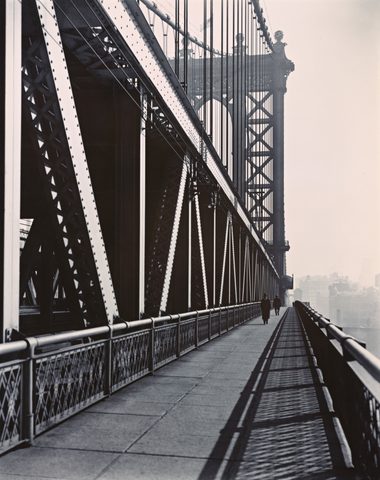
Manhattan Bridge
Berenice Abbott, 1936
About this work
Berenice Abbott made this view on the pedestrian walkway of the Manhattan Bridge in the 1930s for Changing New York, her survey of the city's buildings and streets. The photograph looks along the walkway, striped by the shadows of the railings, as men walk toward the camera beside the steel of the bridge structure. It is listed as number 185 in the project, and the print belongs to the Photography Collection of the New York Public Library, in the Miriam and Ira D. Wallach Division of Art, Prints and Photographs (482600). Abbott began photographing New York on her own after returning from Paris in 1929, and from 1935 to 1939 the Federal Art Project of the Works Progress Administration supported the work, which was published as a book in 1939. The Manhattan Bridge, designed by Leon Moisseiff, is a suspension bridge across the East River that joins Lower Manhattan at Canal Street with Downtown Brooklyn. It opened on 31 December 1909 and soon carried streetcars and, from 1915, subway trains. Abbott was born in Springfield, Ohio, in 1898. She studied sculpture in New York and then lived in Paris, where she worked with Man Ray, before becoming one of the great photographers of American architecture.
Sources: Wikimedia Commons · New York Public Library · Wikipedia: Berenice Abbott · Wikipedia: Manhattan Bridge
FAQ
Where can I buy a framed print of Manhattan Bridge?
Here. Manhattan Bridge is available as a framed print in three sizes: Small (16 × 20 in) for $195, Medium (19 × 24 in) for $295 and Large (28 × 36 in) for $395. Prices include the frame and US shipping; delivery takes 14–21 days, with 30-day returns.
What size works best for Manhattan Bridge?
The file is 6,738 × 8,514 px, so every size is sharp: even Large (28 × 36 in) prints at 237 ppi. Choose Large (28 × 36 in) for a large wall; Small (16 × 20 in) suits a narrower space.
Is it legal to print Manhattan Bridge?
Yes. Berenice Abbott made the photograph for Changing New York, a project of the Federal Art Project of the Works Progress Administration, and Wikimedia Commons lists the New York Public Library's copy as public domain. The print is made from the Library's digitized copy.

















