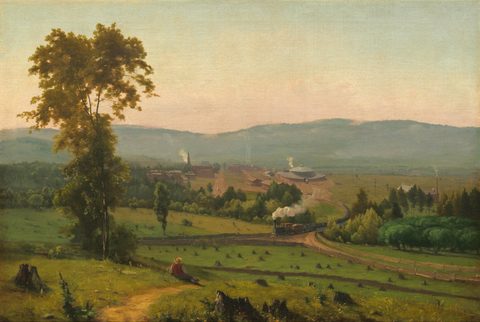
The Lackawanna Valley
George Inness, c. 1856
He sits on the stump hill. The engine is coming. The trees are already gone.
About this work
The Lackawanna Valley, painted around 1855, is one of George Inness's best-known works. It was commissioned in 1855 by John Jay Phelps, the first president of the Delaware, Lackawanna and Western Railroad, and was meant to advertise his company. The view is of the Lackawanna Valley in northeastern Pennsylvania at the site of the railroad's first roundhouse, in Scranton. A train trailing smoke crosses the valley toward the roundhouse and the town beyond, while the foreground is a cleared hillside of tree stumps where a lone figure reclines beneath a tree. Rather than setting the railway against the landscape, Inness folds it into a calm pastoral scene under a soft sky, the kind of view a railroad president could use to show his line as part of the land. The painting is oil on canvas and belongs to the National Gallery of Art in Washington, D.C., a gift of Mrs. Huttleston Rogers.
Sources: Wikipedia · National Gallery of Art
Print facts
- Native resolution
- 5,093 × 3,416 px
- Sharp at 150 ppi up to
- 33 × 22 in
- Sizes
- Small (20 × 13 in) · $100 · 255 ppi
Medium (24 × 16 in) · $150 · 212 ppi
Large (36 × 24 in) · $300 · 141 ppi - Price includes
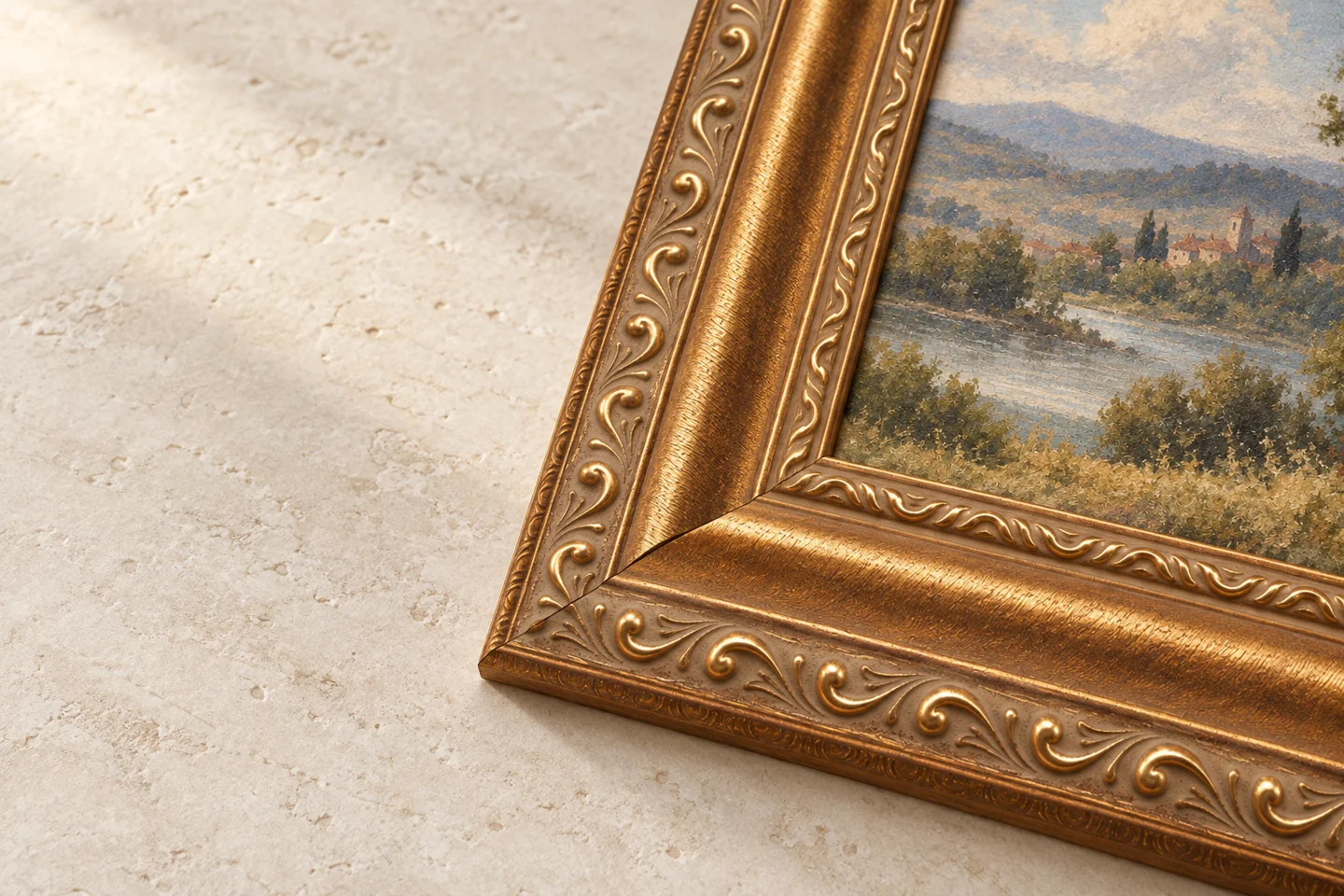
- Frame and US shipping · 14–21 days · 30-day returns
FAQ
Where can I buy a framed print of The Lackawanna Valley?
Here. The Lackawanna Valley is available as a framed print in three sizes: Small (20 × 13 in) for $100, Medium (24 × 16 in) for $150 and Large (36 × 24 in) for $300. Prices include the frame and US shipping; delivery takes 14–21 days, with 30-day returns.
What size works best for The Lackawanna Valley?
The file is 5,093 × 3,416 px. Medium (24 × 16 in) is the largest size that prints at 150 ppi or more (212 ppi), the sharpest choice for close viewing; Large (36 × 24 in) prints at 141 ppi, fine from a few feet away but softer up close.
Is it legal to print The Lackawanna Valley?
Yes. The Lackawanna Valley is in the public domain: its copyright, if it ever had one, expired long ago. In the United States a faithful photograph of a public-domain painting does not create a new copyright (Bridgeman v. Corel, 1999), so the image can be printed and sold freely.