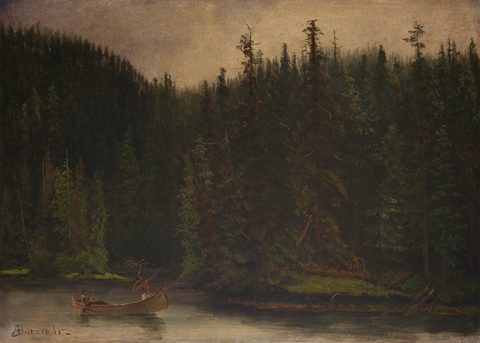
Indian Hunters in a Canoe
Albert Bierstadt, 19th century
Hunters glide across a still mountain lake under tall pines and a golden western sky.
About this work
Indian Hunters in Canoe is an undated oil study by Albert Bierstadt, painted on paper and later mounted on board, measuring 35.2 by 49.2 centimetres. It belongs to the Buffalo Bill Center of the West in Cody, Wyoming (14.60), whose Whitney Western Art Museum holds its collection of paintings of the American West; it was the gift of Carman H. Messmore. A wall of tall dark pines and firs fills most of the picture, rising from the shore of a still lake under a pale golden sky, and a canoe with hunters crosses the water in the foreground, catching a little of the light. Small oil studies on paper like this one were part of how Bierstadt worked, and he used such studies as sources for his large studio canvases. Born in Solingen, Germany, in 1830, he grew up in New Bedford, Massachusetts, and trained in Düsseldorf before travelling west with the surveyor Frederick W. Lander in 1859. He returned to the West many times, including seven weeks in Yosemite Valley with Fitz Hugh Ludlow in 1863, and became one of the best known painters of the second generation of the Hudson River School, celebrated for his theatrical views of the Rocky Mountains and Sierra Nevada.
Sources: Wikimedia Commons · Wikipedia: Albert Bierstadt
FAQ
Where can I buy a framed print of Indian Hunters in a Canoe?
Here. Indian Hunters in a Canoe is available as a framed print in three sizes: Small (20 × 14 in) for $195, Medium (24 × 17 in) for $295 and Large (36 × 26 in) for $395. Prices include the frame and US shipping; delivery takes 14–21 days, with 30-day returns.
What size works best for Indian Hunters in a Canoe?
The file is 6,466 × 4,621 px, so every size is sharp: even Large (36 × 26 in) prints at 178 ppi. Choose Large (36 × 26 in) for a large wall; Small (20 × 14 in) suits a narrower space.
Is it legal to print Indian Hunters in a Canoe?
Yes. Indian Hunters in a Canoe is in the public domain: its copyright, if it ever had one, expired long ago. In the United States a faithful photograph of a public-domain painting does not create a new copyright (Bridgeman v. Corel, 1999), so the image can be printed and sold freely.

















