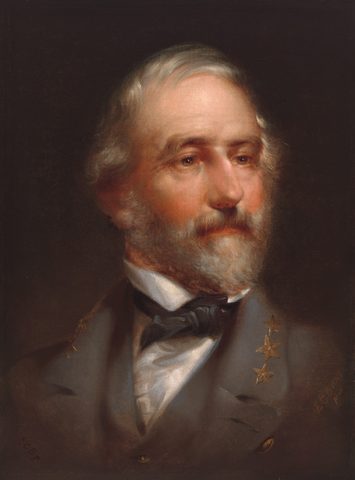
Robert E. Lee
Edward Caledon Bruce, 1865
Lee after Appomattox — Bruce paints the grey commander without the myth varnish.
About this work
This oil portrait of General Robert E. Lee is by the Virginia artist Edward Caledon Bruce. It is dated between 1864 and 1865 and belongs to the Smithsonian's National Portrait Gallery in Washington (NPG.76.4). On its stretcher the canvas measures 52.1 by 39.4 centimetres. Bruce's Wikipedia biography calls it his most famous work and says he painted it in the fall and winter of 1864 to 1865, the last months of the Civil War. Bruce was born in Winchester, Virginia, in 1825. He became deaf in his teens after scarlet fever and studied painting under Thomas Sully in Philadelphia. He was also an author and edited the Winchester Virginian newspaper, and despite his deafness he made sketches of fighting and portraits of notable people during the war. Lee, born in 1807, commanded the Confederacy's Army of Northern Virginia from 1862 until 1865, when he surrendered to Ulysses S. Grant at Appomattox Court House. Later that year he became president of Washington College in Lexington, Virginia, now Washington and Lee University. He died in 1870.
Sources: Wikimedia Commons · National Portrait Gallery · Wikipedia: Edward Caledon Bruce · Wikipedia: Robert E. Lee
FAQ
Where can I buy a framed print of Robert E. Lee?
Here. Robert E. Lee is available as a framed print in three sizes: Small (15 × 20 in) for $195, Medium (18 × 24 in) for $295 and Large (27 × 36 in) for $395. Prices include the frame and US shipping; delivery takes 14–21 days, with 30-day returns.
What size works best for Robert E. Lee?
The file is 2,963 × 4,000 px. Medium (18 × 24 in) is the largest size that prints at 150 ppi or more (165 ppi), the sharpest choice for close viewing; Large (27 × 36 in) prints at 110 ppi, fine from a few feet away but softer up close.
Is it legal to print Robert E. Lee?
Yes. Robert E. Lee is in the public domain: its copyright, if it ever had one, expired long ago. In the United States a faithful photograph of a public-domain painting does not create a new copyright (Bridgeman v. Corel, 1999), so the image can be printed and sold freely.

















