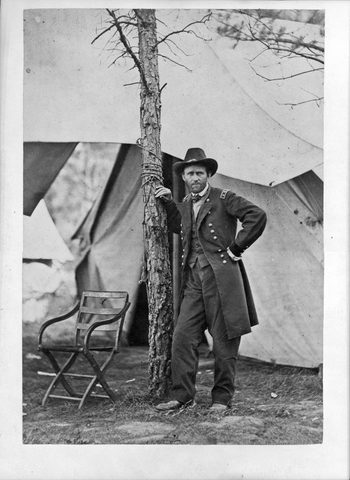
Grant at Cold Harbor
Mathew Brady, 1864
Gen. Ulysses S. Grant at his headquarters at Cold Harbor, Virginia, in June 1864, from the studio of Mathew Brady. From the Library of Congress.
About this work
General Ulysses S. Grant leans against a tree in front of a tent at his headquarters at Cold Harbor, Virginia, in June 1864, in one of the best-known portraits of him, made by a photographer working for Mathew Brady. The Library of Congress holds it among its most requested images (LC 2002736661). Cold Harbor, near Mechanicsville, was one of the last battles of Grant's Overland Campaign, his relentless drive toward Richmond against Robert E. Lee's Army of Northern Virginia. It was fought from 31 May to 12 June 1864, and on 3 June thousands of Union soldiers were killed or wounded in a frontal assault on entrenched Confederate lines, a failure Grant later said he regretted more than any other attack he ordered. He then slipped his army across the James River toward Petersburg, beginning the siege that ended with Lee's surrender at Appomattox in April 1865. Grant, born in Ohio in 1822 and a West Point graduate, was the commanding general of the Union Army by the end of the war. He served two terms as the 18th president of the United States, from 1869 to 1877.
Sources: Library of Congress · Wikipedia: Battle of Cold Harbor · Wikipedia: Ulysses S. Grant
FAQ
Where can I buy a framed print of Grant at Cold Harbor?
Here. Grant at Cold Harbor is available as a framed print in three sizes: Small (15 × 20 in) for $195, Medium (17 × 24 in) for $295 and Large (26 × 36 in) for $395. Prices include the frame and US shipping; delivery takes 14–21 days, with 30-day returns.
What size works best for Grant at Cold Harbor?
The file is 3,028 × 4,155 px. Medium (17 × 24 in) is the largest size that prints at 150 ppi or more (173 ppi), the sharpest choice for close viewing; Large (26 × 36 in) prints at 115 ppi, fine from a few feet away but softer up close.
Is it legal to print Grant at Cold Harbor?
Yes. This photograph was made in 1864, and any copyright on it expired more than a century ago, so it is in the public domain. The Library of Congress lists it with no known restrictions on publication.
















