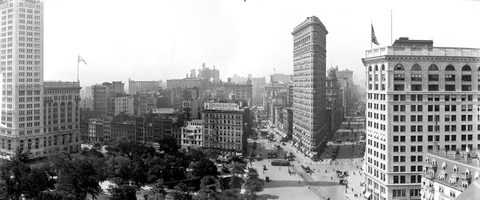
Madison Square and the Flatiron
Unknown photographer, c. 1910–1915
Madison Square crowds around the Flatiron Building.
About this work
This panorama looks south across Madison Square in New York between about 1910 and 1915. The Metropolitan Life Insurance Company Tower rises at far left, Madison Square Park fills the near left, and the triangular Flatiron Building stands near the centre right where Fifth Avenue and Broadway cross. It was stitched together from two photographs by the Detroit Publishing Company, whose originals are in the Library of Congress. The Flatiron Building, originally named the Fuller Building, was designed by Daniel Burnham and Frederick Dinkelberg and opened in 1902. It is 22 storeys and 307 feet tall, and fills a narrow triangular block whose apex at 23rd Street is only about six and a half feet wide. Its steel frame faced in limestone and terracotta made it one of the city's most photographed buildings. The Met Life Tower, modelled on the campanile of St Mark's in Venice, was the tallest building in the world from 1909 until the Woolworth Building opened in 1913. Madison Square, named after President James Madison, was then the heart of a fashionable district of hotels, theatres and shops.
Sources: Library of Congress · Wikipedia: Flatiron Building · Wikipedia: Madison Square and Madison Square Park
FAQ
Where can I buy a framed print of Madison Square and the Flatiron?
Here. Madison Square and the Flatiron is available as a framed print in three sizes: Small (20 × 8 in) for $195, Medium (24 × 10 in) for $295 and Large (36 × 15 in) for $395. Prices include the frame and US shipping; delivery takes 14–21 days, with 30-day returns.
What size works best for Madison Square and the Flatiron?
The file is 15,900 × 6,609 px, so every size is sharp: even Large (36 × 15 in) prints at 441 ppi. Choose Large (36 × 15 in) for a large wall; Small (20 × 8 in) suits a narrower space.
Is it legal to print Madison Square and the Flatiron?
Yes. The Detroit Publishing Company photographs used for this panorama were published more than a century ago and are in the public domain; the Library of Congress lists them with no known restrictions on publication.
















