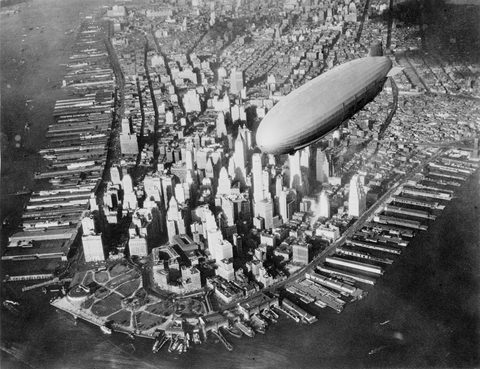
USS Akron over Manhattan
U.S. Navy, c. 1931–1933
The airship Akron flies over the Manhattan skyline.
About this work
This official U.S. Navy photograph, NH 43900 in the collection of the Naval History and Heritage Command, shows the airship USS Akron (ZRS-4) flying over the southern end of Manhattan sometime between 1931 and 1933. Akron was the lead ship of its class and served from September 1931 to April 1933. It was filled with helium and was the world's first purpose-built flying aircraft carrier. It carried Curtiss F9C Sparrowhawk fighters that could be launched and recovered in flight from a trapeze beneath the hull. At 785 feet long, Akron and its sister ship Macon were among the largest flying objects ever built. Only the German Hindenburg and Graf Zeppelin II were slightly longer, and those were filled with hydrogen, so the two Navy airships still hold the record for the largest helium-filled airships. On the morning of April 4, 1933, Akron was destroyed in a thunderstorm off the New Jersey coast. Of the 76 men on board, 73 were killed, among them Rear Admiral William A. Moffett, chief of the Navy's Bureau of Aeronautics. It remains the greatest loss of life in any airship crash. Below the airship are the towers of Lower Manhattan.
Sources: Wikimedia Commons · Naval History and Heritage Command · Wikipedia: USS Akron
FAQ
Where can I buy a framed print of USS Akron over Manhattan?
Here. USS Akron over Manhattan is available as a framed print in three sizes: Small (20 × 15 in) for $195, Medium (24 × 18 in) for $295 and Large (36 × 28 in) for $395. Prices include the frame and US shipping; delivery takes 14–21 days, with 30-day returns.
What size works best for USS Akron over Manhattan?
The file is 5,516 × 4,241 px, so every size is sharp: even Large (36 × 28 in) prints at 151 ppi. Choose Large (36 × 28 in) for a large wall; Small (20 × 15 in) suits a narrower space.
Is it legal to print USS Akron over Manhattan?
Yes. This is an official U.S. Navy photograph, taken in the course of naval duties, which makes it a work of the U.S. federal government and in the public domain. The Naval History and Heritage Command holds it. A print does not imply endorsement by the U.S. Navy.

















