
New York in the 1930s was a city racing upward. In barely a decade, the Chrysler Building, the Empire State Building and Rockefeller Center rose over Manhattan, while older neighborhoods, piers and railroad stations were changing or disappearing around them. A small group of photographers set out to record it all, and their black-and-white pictures remain some of the most beloved images of the city ever made.
This guide introduces the photographers behind the vintage New York City photographs in our catalog, from Berenice Abbott and Lewis Hine to the commercial studios that documented the skyline, with ideas for choosing and hanging them at home.
These pictures caught New York in the act of becoming itself.
Berenice Abbott and Changing New York
Berenice Abbott was born in Ohio in 1898 and spent much of the 1920s in Paris, where she worked as an assistant to Man Ray before opening her own portrait studio. There she came to admire Eugène Atget, the elderly photographer who had spent decades recording the streets of old Paris, and after his death in 1927 she helped preserve and champion his work. When she returned to New York in 1929, she saw the city through the same lens: a place whose history was being demolished and rebuilt faster than anyone was documenting it.
In 1935 the Federal Art Project, part of the New Deal’s Works Progress Administration, began funding her ambitious survey of the city, known as Changing New York. Working with a large-format camera, Abbott photographed skyscrapers and storefronts, bridges and back streets. A selection was published as a book in 1939, and large holdings of the project are now at the New York Public Library and the Museum of the City of New York.
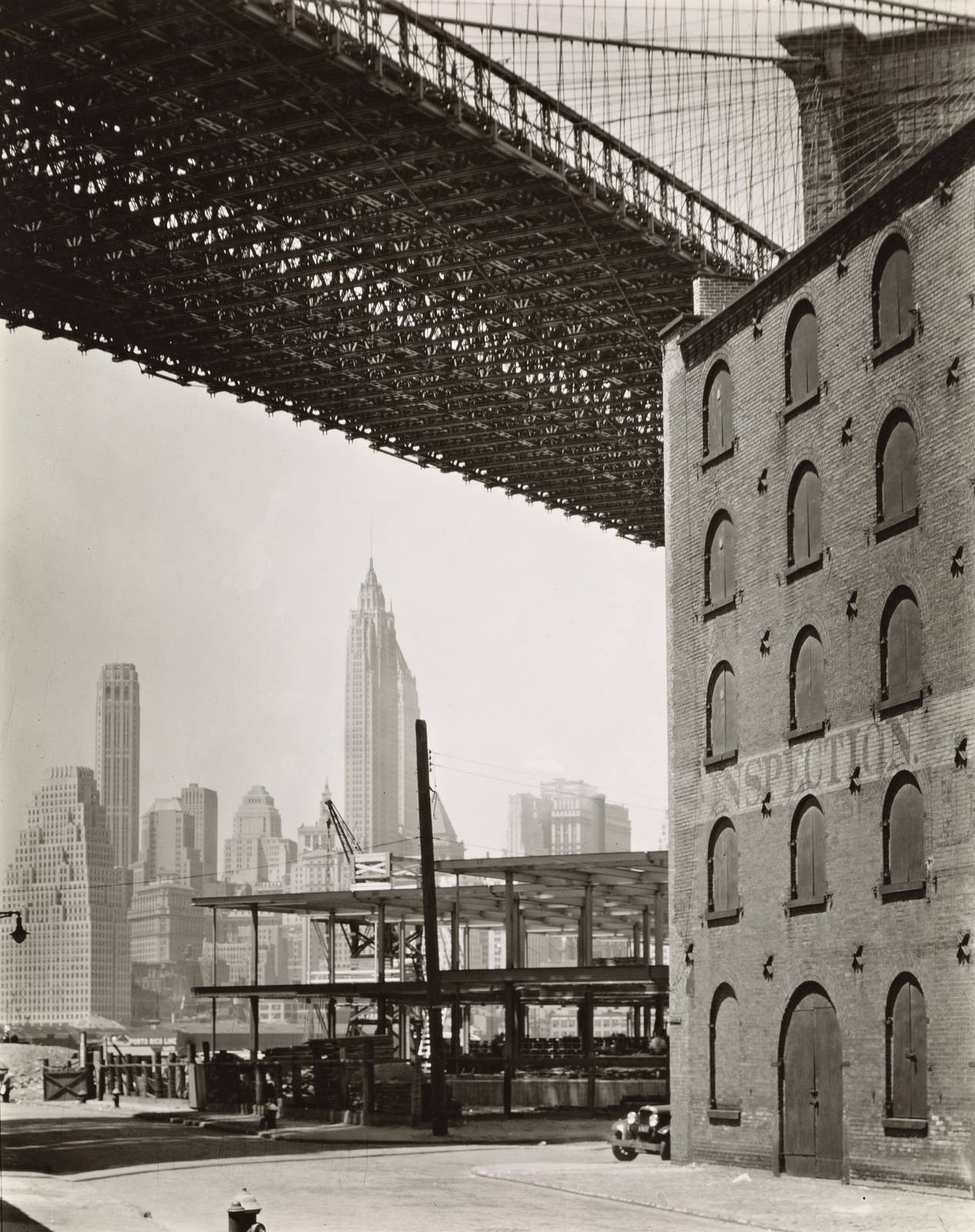
Her Brooklyn Bridge, Water and Dock of 1936 looks up at the great bridge from the waterfront, and her Manhattan Bridge of the same year turns its steel towers into an almost abstract pattern. Wall Street, made in 1938 from the roof of the Irving Trust building, looks down the narrow canyon toward the East River. At street level, Pike and Henry of 1936 captures a Lower East Side corner, and Theoline, Pier 11 shows a sailing schooner docked on the East River, a reminder that sail still worked the harbor in the age of the skyscraper. See more in our Berenice Abbott collection.
The lost Penn Station
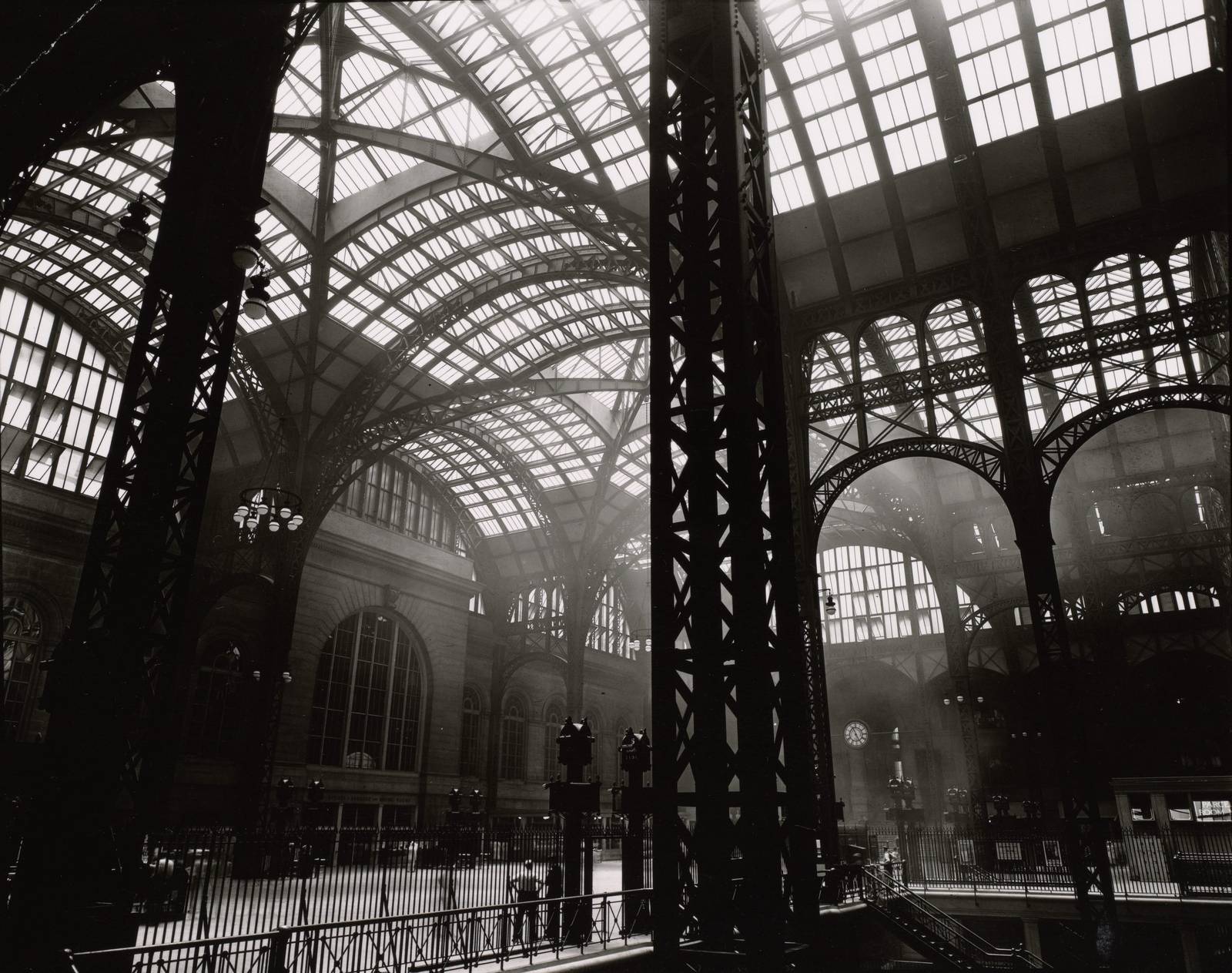
Some of Abbott’s photographs have become historical records of places that no longer exist. Pennsylvania Station, designed by McKim, Mead & White and opened in 1910, was one of the grandest buildings in America. Abbott’s Penn Station concourse of 1936 shows its soaring lattice of steel and glass. Demolition began in 1963, and the public outcry helped lead to the creation of New York City’s Landmarks Preservation Commission in 1965. For anyone who commutes through the station today, this print is a reminder of what was lost, and it makes a memorable gift.
Lewis Hine and the men who built the Empire State
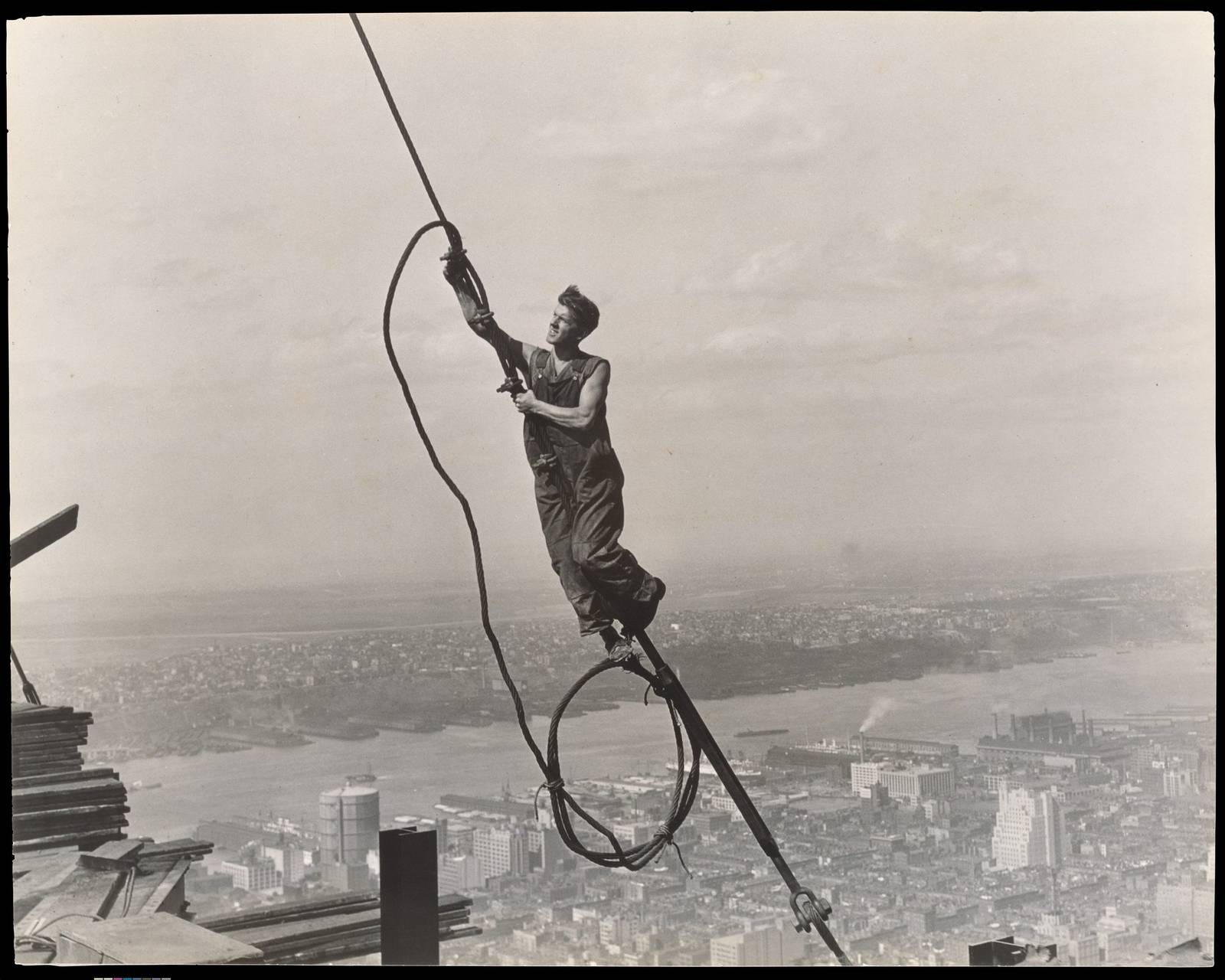
Lewis Hine began his career as a teacher and is best known for the photographs of working children he made for the National Child Labor Committee in the early 1900s, pictures that helped build support for child labor laws. Late in his career he turned to celebrating work rather than exposing its abuses. In 1930 and 1931 he photographed the construction of the Empire State Building, which opened on May 1, 1931, climbing out onto the steel with the ironworkers to get his pictures. Many of them appeared in his 1932 book Men at Work.
Icarus is the most famous: a worker silhouetted against the sky high above the city, named for the figure of Greek myth. Workman on the Empire State Framework and Old-timer structural worker show Hine’s ironworkers up close. As a group of two or three Small prints in a hallway or home office, they make a powerful tribute to skilled labor.
Hine climbed out onto the steel with the ironworkers to get his pictures.
Lunch atop a Skyscraper
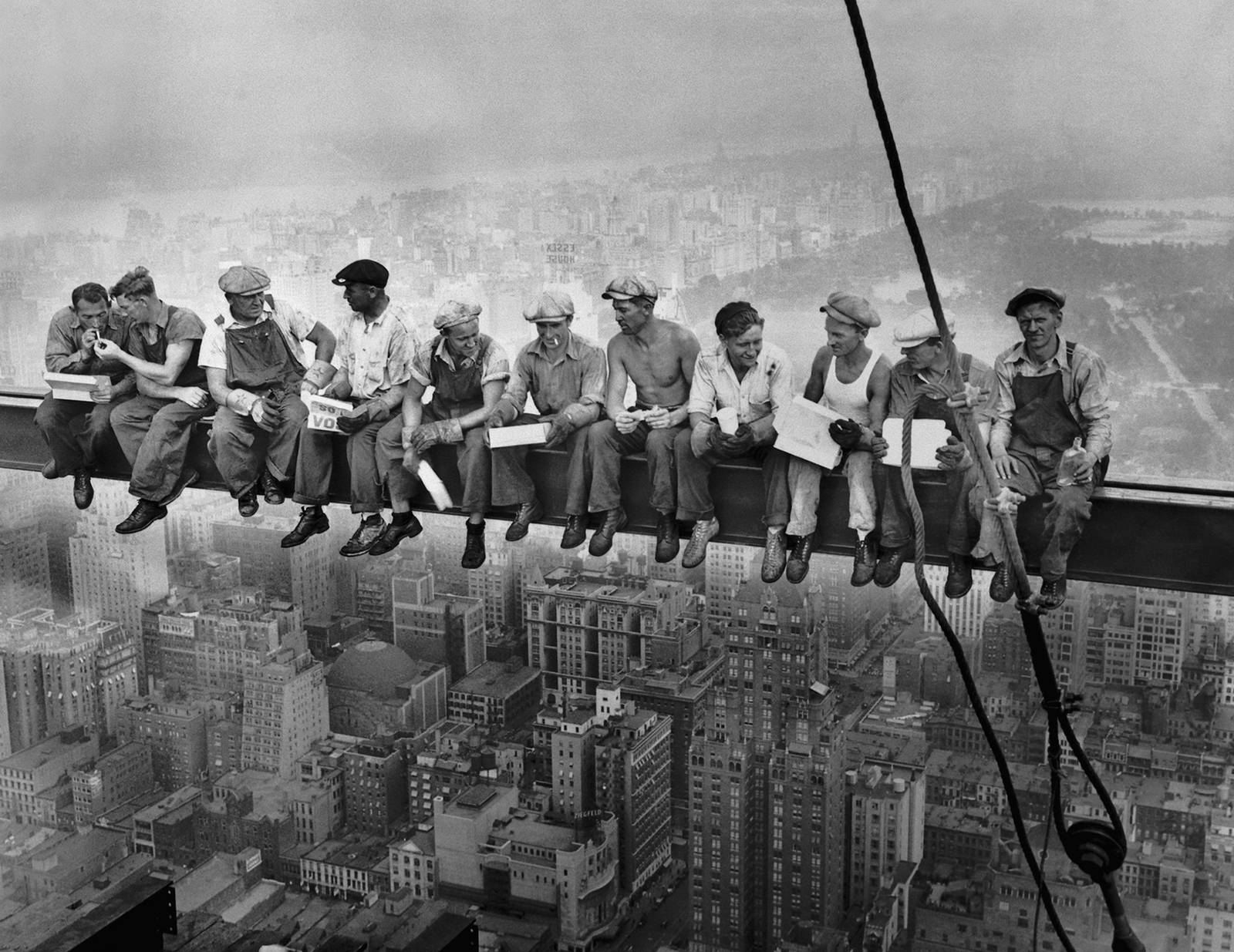
No photograph of 1930s New York is better known than Lunch atop a Skyscraper, taken in 1932 during the construction of the RCA Building at Rockefeller Center. Eleven ironworkers sit along a steel beam, eating and smoking, with Central Park and Midtown far below. It has long been credited to Charles C. Ebbets, though several photographers were on the site that day and the attribution has been debated. Whoever pressed the shutter, it has become a symbol of the city’s confidence in the depths of the Depression.
The finished complex appears in Samuel H. Gottscho’s Rockefeller Center of 1933. Gottscho, a leading architectural photographer, also made Chrysler Building in 1932, showing William Van Alen’s Art Deco tower, which briefly reigned as the tallest building in the world after its completion in 1930 until the Empire State overtook it. Both are in the Library of Congress.
Earlier views and great interiors
For an earlier New York, the Detroit Publishing Company’s Flatiron Building of 1905 shows Daniel Burnham’s wedge-shaped tower only a few years after it was completed in 1902. And John Collier Jr.’s Sunlight in Grand Central Terminal, made in October 1941, captures shafts of light streaming through the tall windows of the main concourse, one of the most atmospheric interiors ever photographed.
Choosing and hanging New York photographs
- Black-and-white loves black frames. Our slim Black Metallic frame suits vintage photographs, giving them a crisp, gallery look in modern apartments, offices and lofts.
- Build a skyline wall. Group bridges, towers and street scenes in matching frames. Three or four prints of the same size, hung with even spacing, read as a single installation.
- Go big with the icons. Lunch atop a Skyscraper and Penn Station concourse are detailed enough to hold a wall on their own at Large. Each work comes framed in up to three sizes, Small at $195, Medium at $295 and Large at $395. Our guide to choosing a size and frame explains how to pick.
- Think about who they are for. A New Yorker who moved away, a commuter, an architect or a construction worker will each find a picture here that speaks to them.
Every print is made to order and ships free within the US. Browse the full New York City photographs collection, or look up at more towers in our skyscraper photographs.