
A bridge usually promises a destination. Monet’s Japanese footbridge offers something stranger: a crossing that seems to lead deeper into looking. Its gentle arch steadies a thicket of leaves, flowers and reflections, but the water below refuses to settle into a single surface. One moment it is a pond; the next it is an upside-down garden. The little structure gives us our bearings just long enough for the painting to take them away. That tension helps explain why two pictures of the same bridge can feel so different—and why one familiar view never quite substitutes for another.
The setting was Giverny, where Claude Monet moved in 1883. As the National Gallery of Art’s account explains, he first rented his house, then bought it seven years later. In 1893 he acquired adjacent wet ground and sought permission to divert a stream. These are useful details because they complicate the easy picture of an Impressionist simply arriving before a beautiful scene. This scene had to be assembled. Before the painted garden came the work of making a garden worth painting, with its own water, plantings and intervals of open space.
Before the pond, an appetite for patterns
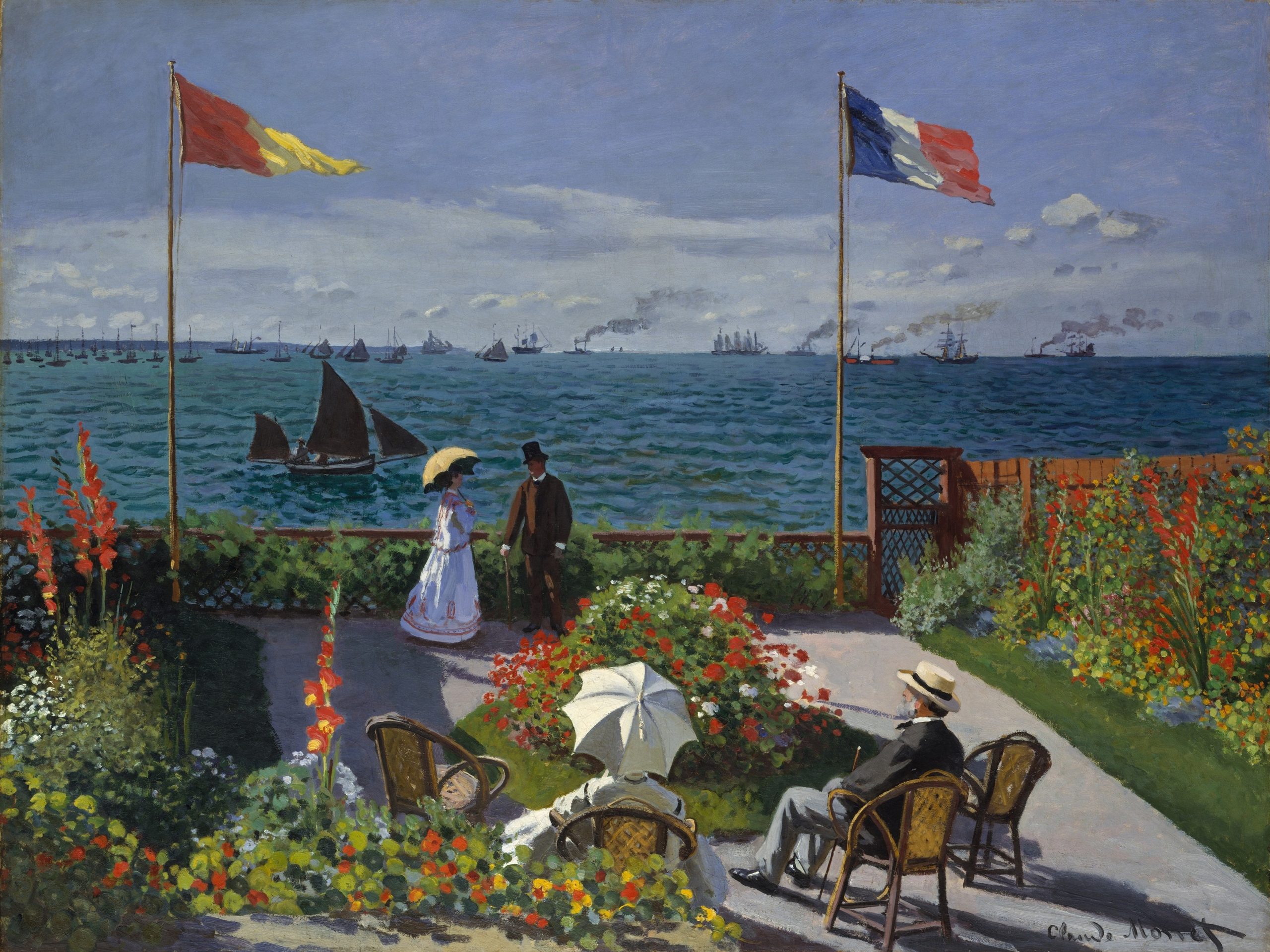
There is a revealing earlier stop in Garden at Sainte-Adresse, painted in 1867 and now at the Metropolitan Museum of Art. Here the eye moves through a seaside terrace toward the water and a broad sky. Flowers, chairs, figures and flagpoles divide the scene into an arrangement as legible as a well-set table. The Met points to the elevated viewpoint and the picture’s distinct horizontal zones. Already, looking is not just a matter of reporting what stands in front of the painter. It is a matter of deciding how the world will be organized inside a rectangle.
Giverny changes the terms. The view draws inward rather than outward, away from the open coast and into an enclosure of green. The National Gallery in London connects the bridge to Monet’s interest in Japanese prints, including a Hiroshige print he owned showing a curved bridge. That relationship need not make the pond an imitation of a place in Japan. It is more interesting as an exchange of pictorial ideas: an arch, a cropping decision, a way of making a familiar piece of ground feel newly composed.
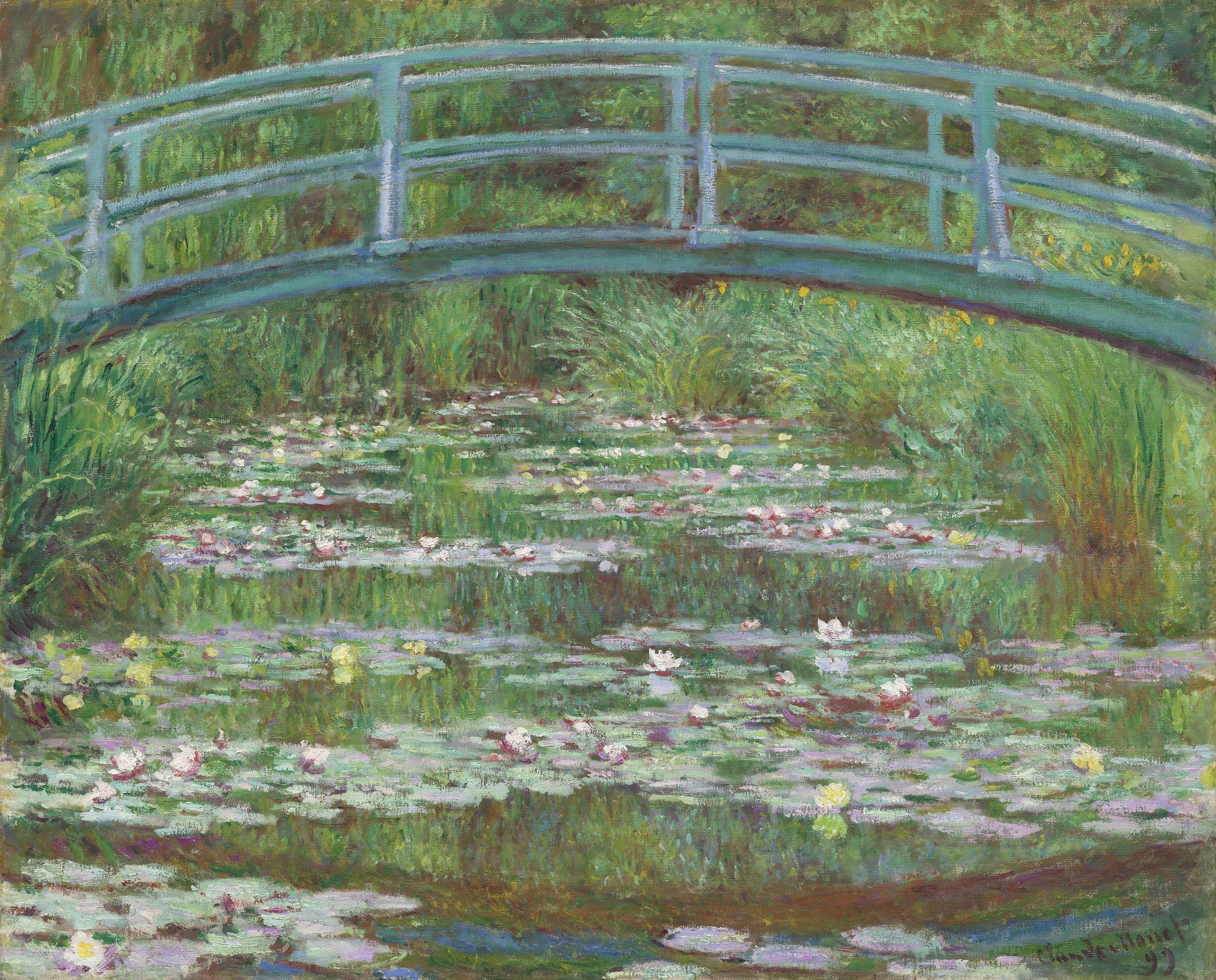
In the Washington Japanese Footbridge of 1899, the bridge rides high in the composition. Greenery fills the space behind it; the usual reassurance of an open sky is withheld. Below, patches of lilies interrupt the reflections without fully separating us from them. The eye tries to move back into depth, then finds itself following touches of color across the canvas. Nothing requires us to choose between those experiences. The painting is both a place we can imagine entering and a surface whose marks keep bringing us home.
Before the painted garden came the work of making a garden worth painting.
Why one bridge became many
The bridge paintings belong to a sustained investigation, not a search for a single definitive likeness. London’s National Gallery records early bridge views in 1895, a return to the subject in 1899, and an exhibition of twelve related paintings in December 1900. The important point is not an inflated count of every bridge Monet ever painted. It is the discipline of returning. Keep the basic arrangement recognizable and every adjustment begins to matter: the amount of water visible, the weight of the leaves, the color that holds the bridge together.
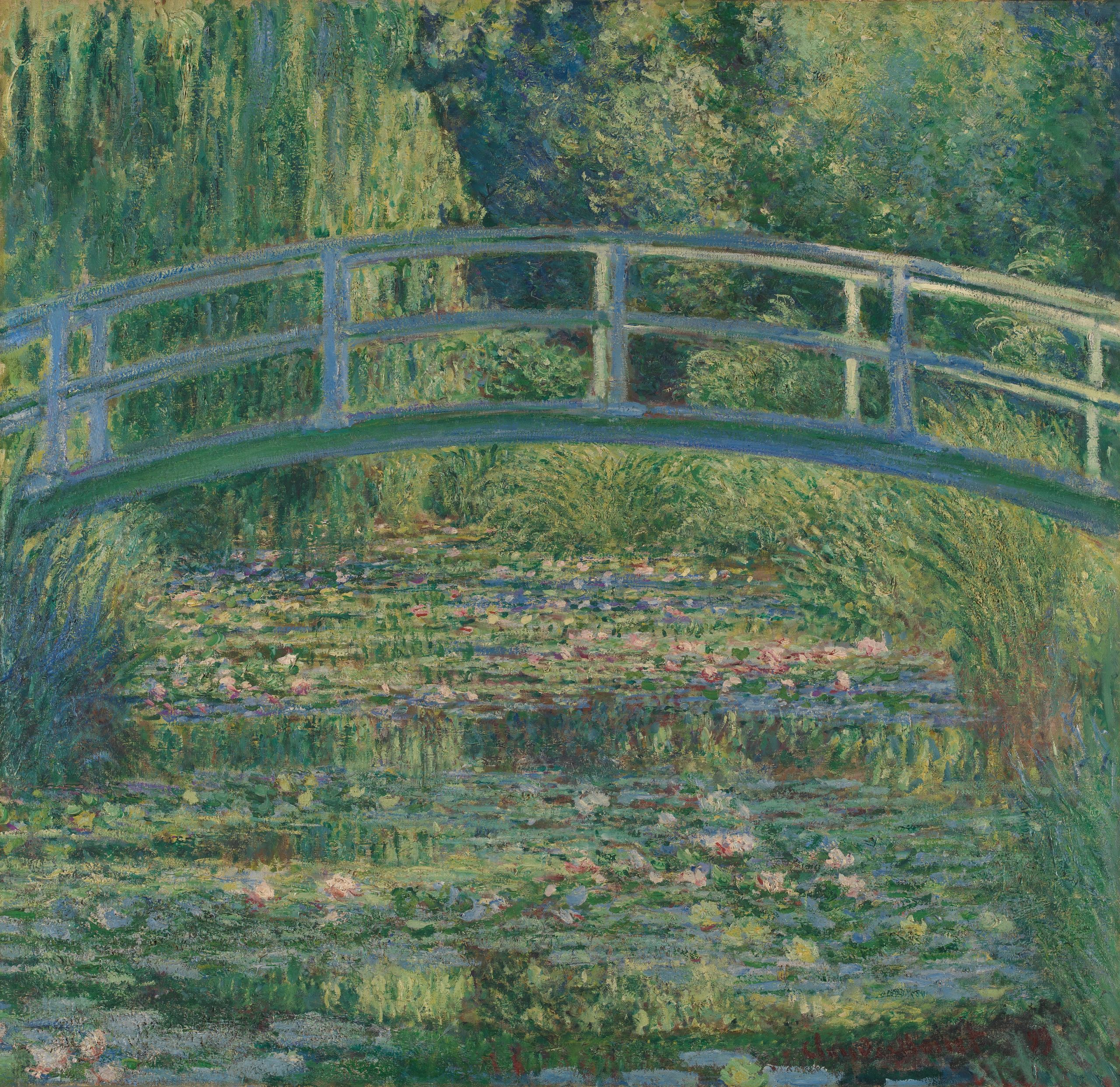
London’s The Water-Lily Pond, also dated 1899, rewards comparison with Washington’s canvas. Its arch reaches across the width of the image, while the vegetation and clustered pads make the foreground busy with small incidents. The National Gallery describes the shifting perspective: we appear to look toward the bridge and down into the water at once. This is not a flaw to solve. It is the mechanism of the picture. A garden that might be traversed in a few steps becomes a space the eye can keep negotiating.
Looking at versions side by side is therefore less like choosing a favorite photograph than listening to several performances of the same music. The structure remains; the emphasis moves. In one, the bridge seems to command the scene. In another, its rails begin to dissolve into the surrounding growth. You can follow a dark reflection first, then a pale flower, then a vertical streak of green. The painting changes with the route you take through it, even before you notice the differences between canvases.
When the bridge falls away
The later water-lily pictures make that uncertainty more expansive. The National Gallery’s discussion of Monet’s pond paintings traces a gradual elimination of solid banks and overhanging trees, which can survive as reflections rather than objects directly shown. A horizon is no longer needed to tell us which way the world runs. Water can hold flowers, weather and an image of the sky in the same field. The subject has become smaller in geographic terms and larger in what it allows the painter to do.
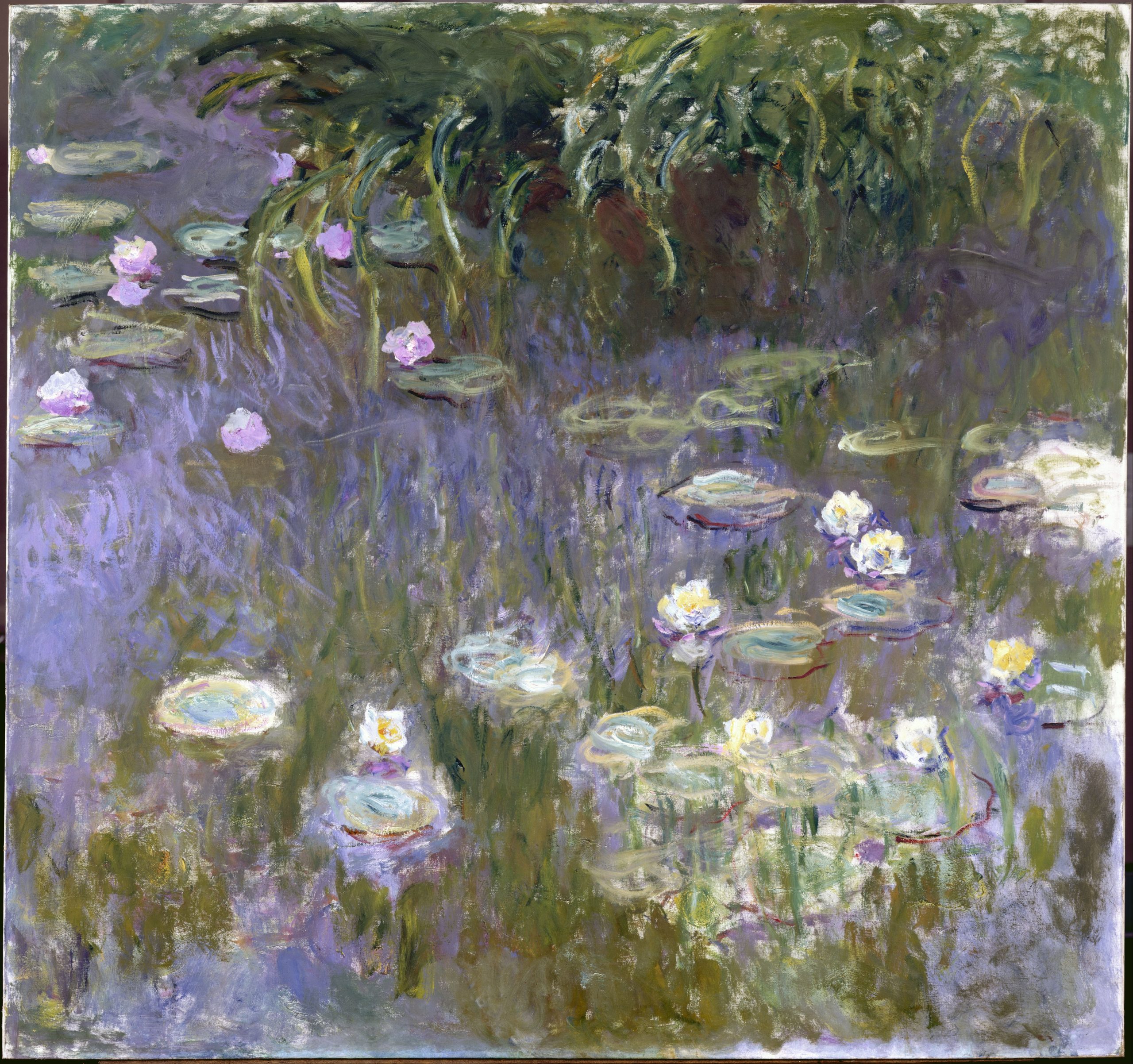
Toledo’s Water Lilies, dated about 1922, belongs to this late world. The museum identifies it as an apparent study for Morning, part of the great decorative project at the Orangerie. Here it is useful to stop asking where a path would lead or where a person could stand. Look instead for intervals: a light passage against a dark one, floating pads against reflected growth, a brushstroke that describes a thing and also insists on being paint. The pleasure is not the disappearance of nature but its release from a tidy diagram.
The bridge gives us a particularly generous entrance to this story because it is so recognizable. We know what bridges do. Monet lets that knowledge establish a foothold, then asks us to spend more time with everything around and beneath it. At Giverny, repetition was not the enemy of discovery. It was the condition that made discovery possible. A small garden could sustain a long attention; a short arch could open onto an almost unbounded world. That is a good reason to return to the pictures slowly, and to resist expecting them all to say the same thing.
Explore more works by Claude Monet in the collection.