
A dining room is the one room in most homes built entirely around sitting still. People stay at the table for an hour or two, facing the same walls, and in the weeks around Thanksgiving and the holidays that table gets busier than at any other time of year. That makes the dining room one of the best places in the house for a single strong painting: something worth looking at between courses, and something that starts a conversation.
Painters have been celebrating meals for as long as there have been patrons to hang them. Below are our favorite dining room picks from the catalog, grouped by mood, with practical notes on size and placement at the end.
The dining room is the one room in most homes built entirely around sitting still.
The long lunch: Renoir’s Luncheon of the Boating Party
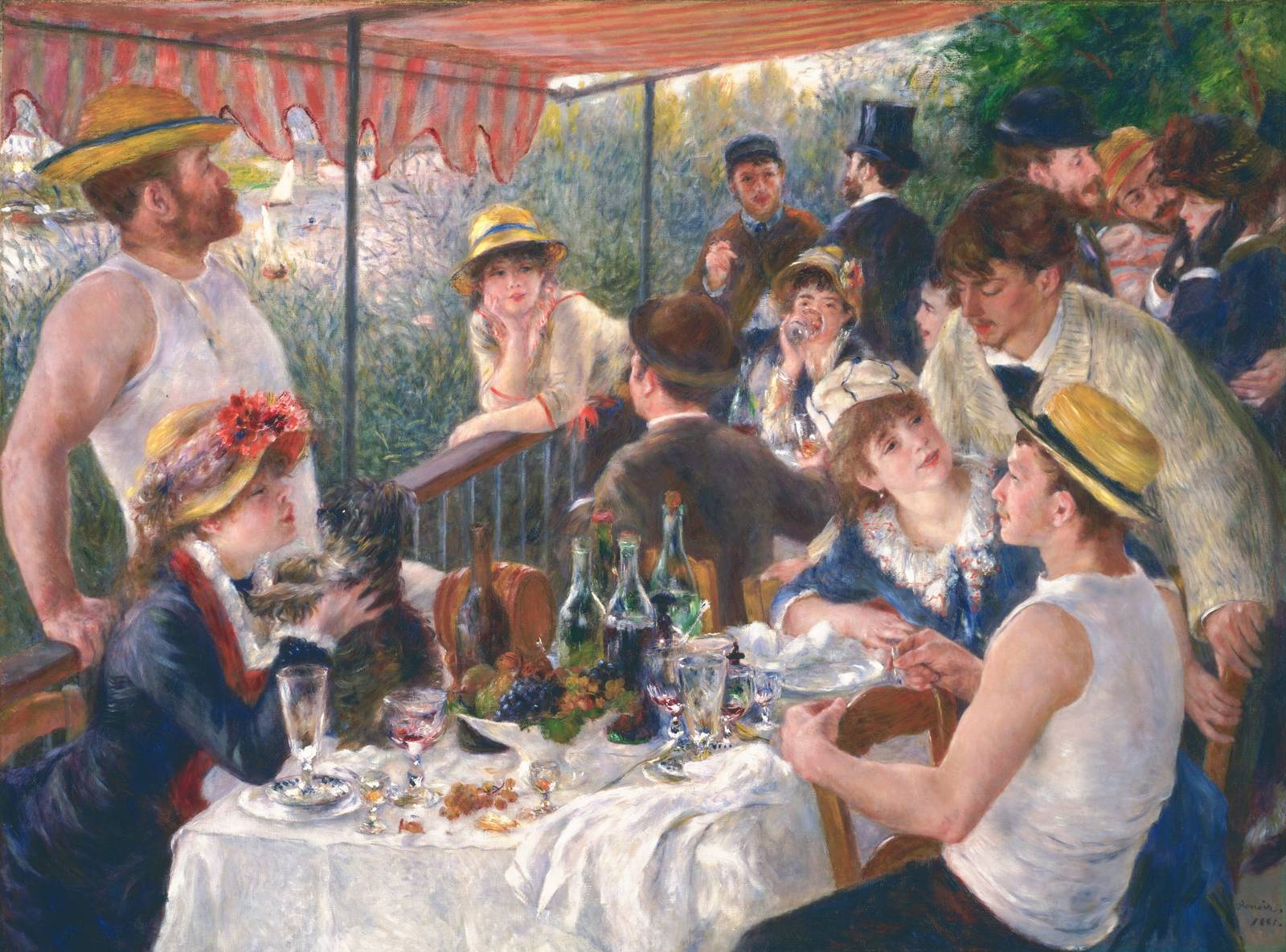
If one painting was made for a dining room, it is Luncheon of the Boating Party. Renoir set it on the balcony of the Maison Fournaise, a restaurant on an island in the Seine at Chatou, west of Paris, where rowers and their friends gathered on summer weekends. The meal is nearly over: glasses half empty, fruit scattered on the white cloth, and everyone talking, flirting or leaning on the railing under a striped awning. The models were Renoir’s friends, among them Aline Charigot, the young woman playing with a small dog at left, whom he later married, and the painter Gustave Caillebotte, seated at lower right in a boater.
The canvas belongs to the Phillips Collection in Washington, D.C. Its wide format suits the long wall above a sideboard or buffet, and its blues, whites and warm skin tones work in both traditional and modern rooms.
Family breakfast: Monet’s The Luncheon
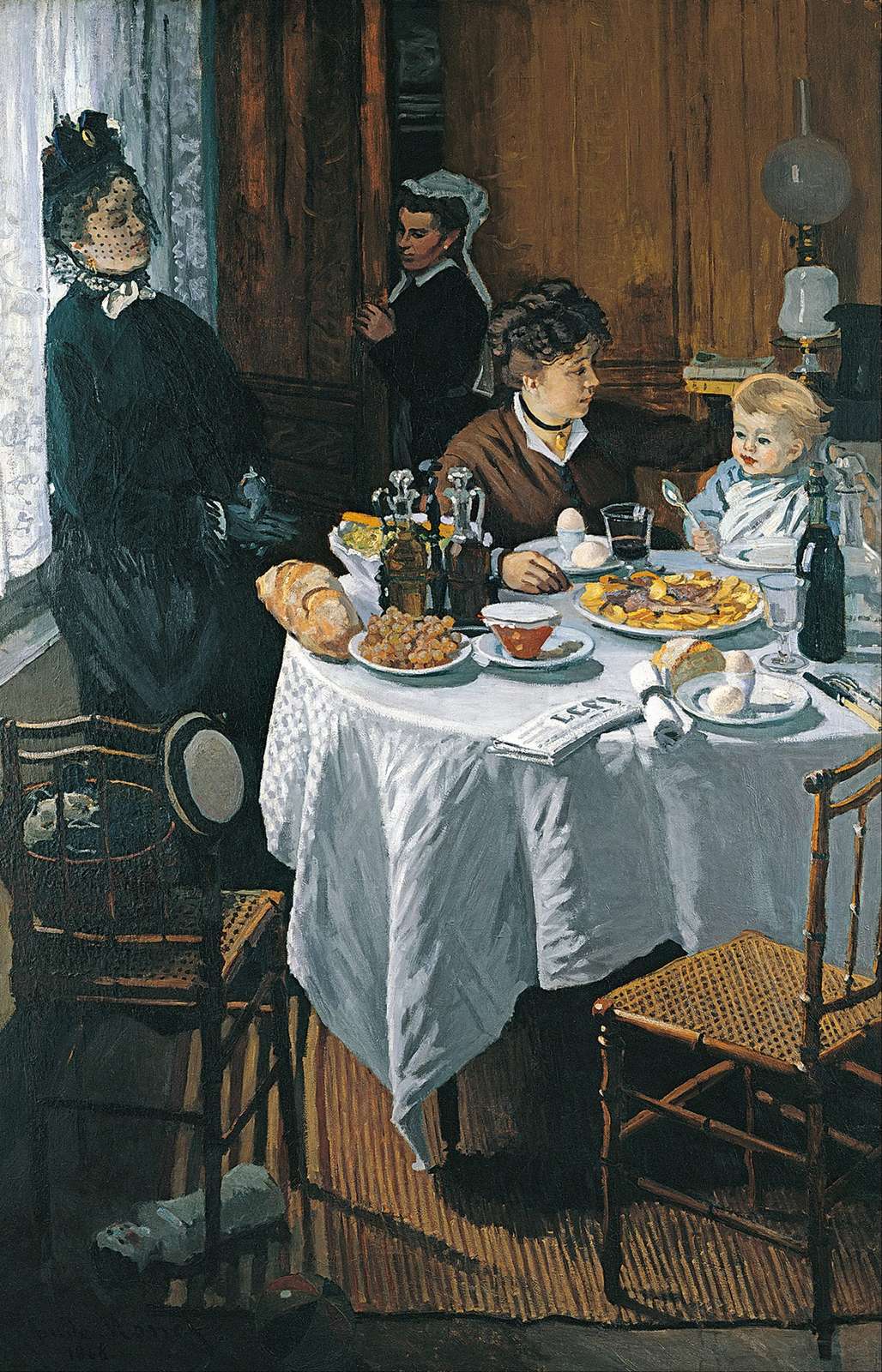
Before he was the painter of water lilies, Monet painted his own household. The Luncheon (1868), painted in Étretat on the Normandy coast, shows his companion Camille Doncieux and their young son Jean at a table laid with bread, eggs and fruit, with an empty place set for the painter himself, a visitor at the window and a maid at the door. Morning light falls across the white tablecloth. Monet submitted it to the Paris Salon of 1870, and the jury rejected it; today it is one of the treasures of the Städel Museum in Frankfurt. It is a tall picture, so it fits a narrow wall between windows or beside a doorway, where a horizontal piece would feel cramped.
Dinner under the stars: Van Gogh’s Café Terrace at Night
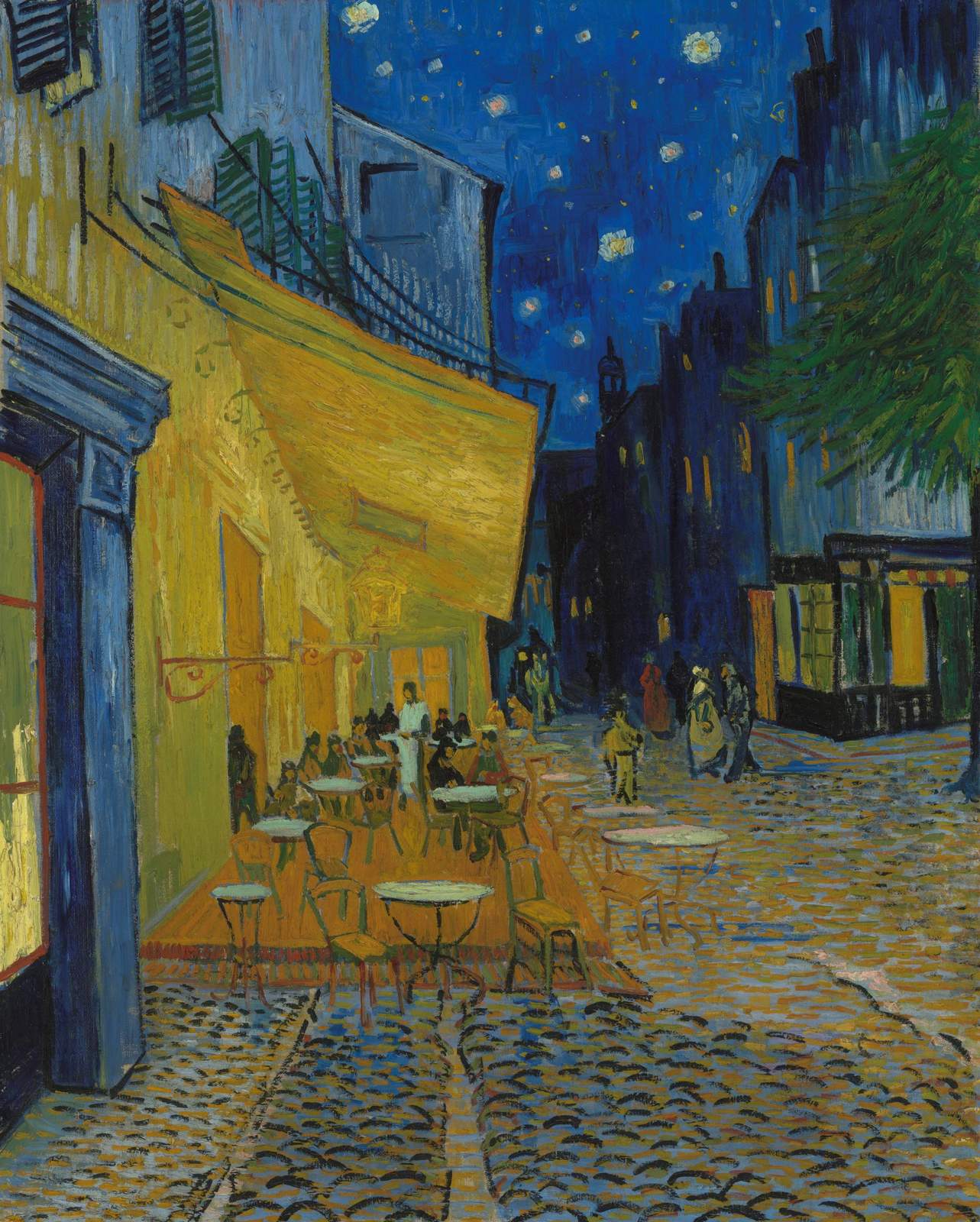
For an evening mood, nothing beats Café Terrace at Night. Van Gogh painted it in September 1888 on the Place du Forum in Arles, working outdoors after dark: a yellow awning glows over tables on the cobblestones while a deep blue sky full of stars opens above the street. It was one of the first paintings in which he set a starry sky, and he did it without a speck of black. It now hangs in the Kröller-Müller Museum in the Netherlands. The yellow and blue look wonderful against white, navy or warm wood, and the scene makes a dining room feel like a corner bistro.
Café Terrace at Night makes a dining room feel like a corner bistro.
The table itself: Dutch and Flemish still lifes
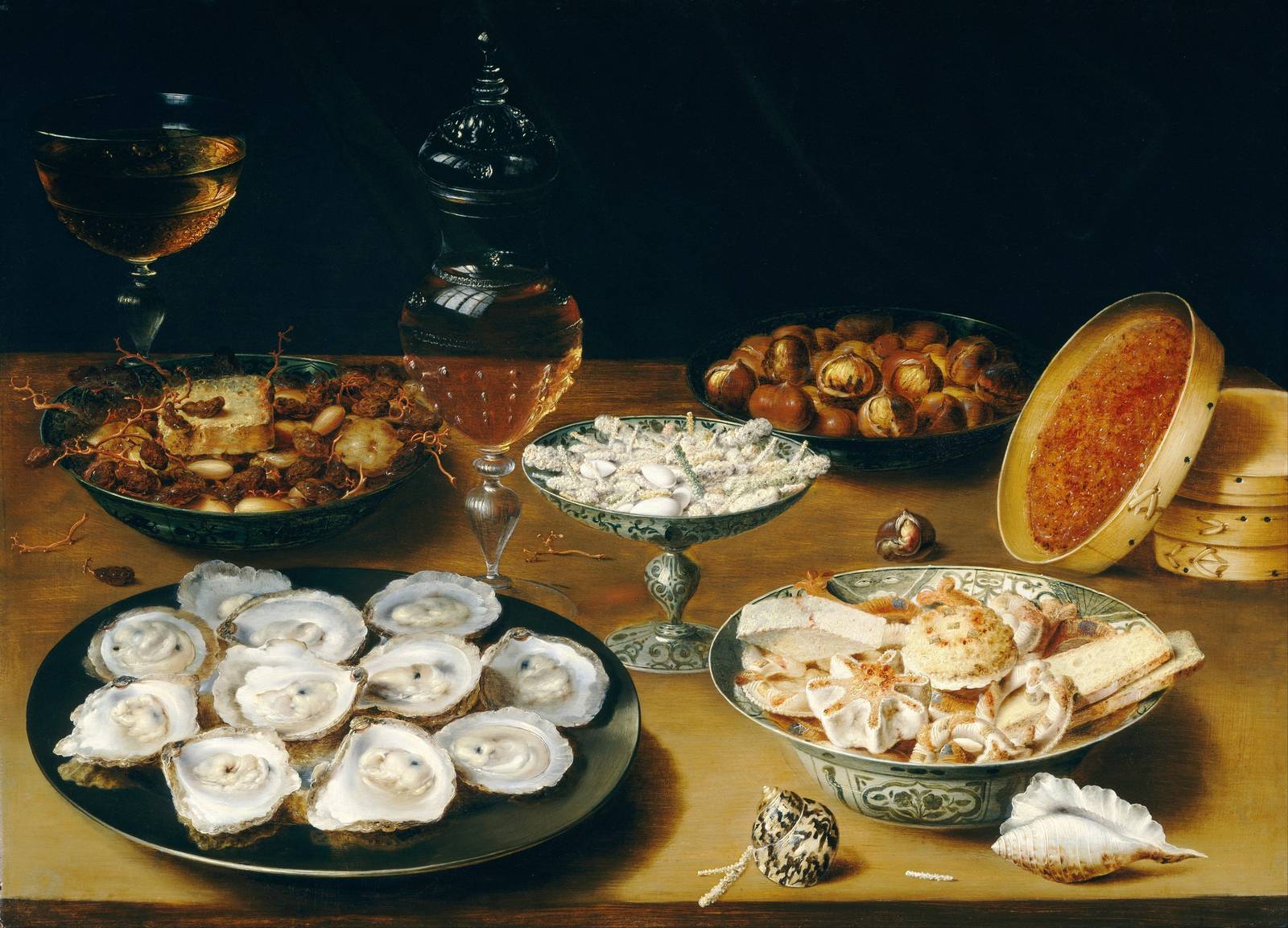
In the seventeenth-century Low Countries, painting a beautifully laid table became a specialty of its own. Osias Beert the Elder, working in Antwerp, was one of the pioneers of the “breakfast piece,” a close-up of a table set with costly food. His Dishes with Oysters, Fruit, and Wine (about 1620–25), in the National Gallery of Art in Washington, lines up oysters, fruit and wine against a dark ground, each dish seen from slightly above, as if you were about to pull up a chair. Still lifes like this suit smaller dining rooms and breakfast nooks, and they look especially good in a dark wood or gold frame.
For a still life with people in it, Vermeer’s The Girl with the Wine Glass (about 1659–60, Herzog Anton Ulrich Museum, Braunschweig) shows a young woman in a red silk dress being offered a glass of wine by an attentive suitor, while a second man sits gloomily at the table and a bowl of oranges catches the light from a stained-glass window. It is a quiet, slightly mysterious scene, ideal for a formal dining room.
Harvest and abundance
A harvest picture brings the source of the meal to the table. Cesare Dell’Acqua’s The Grape Harvest in Pompeii (1874) imagines a Roman family under a sunlit vine, the father holding up a bunch of grapes, against a red wall painted in the Pompeian style. It is a natural choice for a wine lover’s dining room. For an American take, Asher B. Durand’s The First Harvest in the Wilderness (1855, Brooklyn Museum) shows a settler’s small wheat field cut out of the forest, a fitting picture for a Thanksgiving table.
How to size and hang dining room art
- Over a sideboard or buffet: aim for art about two-thirds the width of the furniture, hung with the bottom of the frame roughly 6 to 10 inches above its top. A wide painting such as the Renoir or the Dell’Acqua is ideal here.
- Hang for seated eyes. People in a dining room are usually sitting, so on a bare wall hang the center a little lower than you would in a hallway, around 55 to 57 inches from the floor rather than 60.
- Mind the chandelier. Center the piece on the table or the sideboard, not the wall, and keep it out of the glare of a lamp or a window directly opposite.
- One big piece beats many small ones. A single Large framed print reads clearly from across the table; a cluster of small frames can look busy behind a crowd of chairs.
- Size it. Every work comes framed and ready to hang in up to three sizes, Small at $195, Medium at $295 and Large at $395, printed at true proportions without cropping. Our wall art size guide helps you pick.
Looking for more? Browse our Impressionist paintings, the Van Gogh collection or the full Masterpieces collection for more pictures worth sitting down with.