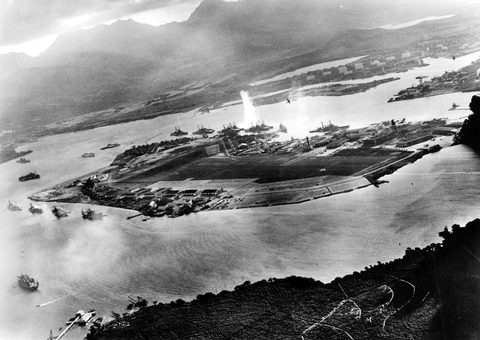
Pearl Harbor from the air
U.S. Navy, 1941
World War II · On the Frontline
Battleship Row at Pearl Harbor photographed from a Japanese plane during the torpedo attack on 7 December 1941, with ships moored on both sides of Ford Island.
About this work
This photograph was taken from a Japanese plane during the torpedo attack on the ships moored on both sides of Ford Island, shortly after the attack on Pearl Harbor began on December 7, 1941. The U.S. Naval History and Heritage Command catalogues it as NH 50930. The view looks roughly east, with the supply depot, submarine base and fuel tank farm in the distance. A torpedo has just hit USS West Virginia on the far side of Ford Island. Nearby, from the left, are the battleships Nevada, Arizona, Tennessee, Oklahoma, which has been torpedoed and is listing, Maryland and California. The seven battleships moored beside Ford Island, the group known as Battleship Row, took the brunt of the Japanese assault. The attack was launched from aircraft carriers against the U.S. Pacific Fleet at its base on Oahu, Hawaii, while the United States was still neutral in the Second World War, and the next day the United States declared war on Japan. Japanese planners called it the Hawaii Operation.
Sources: Wikimedia Commons · Wikipedia: Attack on Pearl Harbor · Wikipedia: Battleship Row
FAQ
Where can I buy a framed print of Pearl Harbor from the air?
Here. Pearl Harbor from the air is available as a framed print in three sizes: Small (20 × 14 in) for $195, Medium (24 × 17 in) for $295 and Large (36 × 26 in) for $395. Prices include the frame and US shipping; delivery takes 14–21 days, with 30-day returns.
What size works best for Pearl Harbor from the air?
The file is 6,404 × 4,543 px, so every size is sharp: even Large (36 × 26 in) prints at 175 ppi. Choose Large (36 × 26 in) for a large wall; Small (20 × 14 in) suits a narrower space.
Is it legal to print Pearl Harbor from the air?
Yes. The photograph was taken by the Imperial Japanese Navy in 1941 and later published by the U.S. Navy as an official photograph (NH 50930). Wikimedia Commons lists it as public domain because Japanese copyright in photographs of that age has expired, and the print is made from that public-domain copy.

















