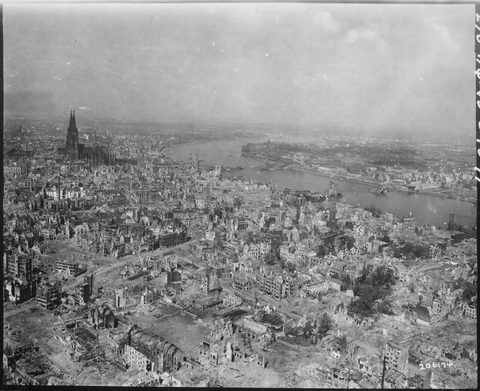
Cologne Cathedral
U.S. Army Air Forces, 1945
Cologne Cathedral still standing amid the ruins of the city in 1945. U.S. Army Air Forces photograph from the National Archives.
About this work
This 1945 photograph by the U.S. Army Air Forces shows Cologne Cathedral still standing above the ruined centre of the city at the end of the Second World War. It was made on 4 by 5 inch film and is held by the U.S. National Archives (NARA 531287). Cologne was bombed in 262 separate air raids during the war, all of them by the Royal Air Force, and about 34,700 long tons of bombs fell on the city, killing some 20,000 civilians. The first bombing came on 12 May 1940, and on the night of 30 to 31 May 1942 Cologne was the target of the first thousand-bomber raid, codenamed Operation Millennium. The cathedral was hit many times but its twin spires survived, and in photographs like this one they rise over streets reduced to rubble. Kölner Dom is the seat of the Archbishop of Cologne and a monument of Gothic architecture. Building began in 1248, stopped around 1560 and resumed in the nineteenth century, when the church was finally completed to its medieval plan. At 157 metres it is the tallest twin-spired church in the world, it was declared a World Heritage Site in 1996, and it is Germany's most visited landmark.
Sources: U.S. National Archives · Wikipedia: Cologne Cathedral · Wikipedia: Bombing of Cologne in World War II
FAQ
Where can I buy a framed print of Cologne Cathedral?
Here. Cologne Cathedral is available as a framed print in two sizes: Small (20 × 16 in) for $195 and Medium (24 × 20 in) for $295. Prices include the frame and US shipping; delivery takes 14–21 days, with 30-day returns.
What size works best for Cologne Cathedral?
The file is 3,000 × 2,446 px. Small (20 × 16 in) is the largest size that prints at 150 ppi or more (150 ppi), the sharpest choice for close viewing; Medium (24 × 20 in) prints at 122 ppi, fine from a few feet away but softer up close.
Is it legal to print Cologne Cathedral?
Yes. The photograph was made in 1945 by the U.S. Army Air Forces, and works made by U.S. federal employees as part of their duties are not protected by copyright in the United States. The print is made from the copy held by the U.S. National Archives.
















