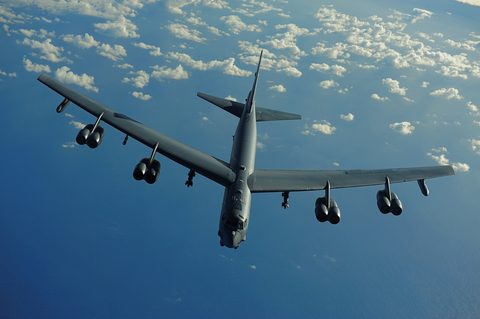
B-52 Stratofortress
USAF / Jacob N. Bailey, 2010
A B-52 Stratofortress of the 20th Expeditionary Bomb Squadron over the Pacific during the Rim of the Pacific exercise, 10 July 2010. Photograph by Tech. Sgt. Jacob N. Bailey.
About this work
This U.S. Air Force photograph by Tech. Sgt. Jacob N. Bailey shows a B-52 Stratofortress of the 20th Expeditionary Bomb Squadron, from Barksdale Air Force Base, Louisiana. The bomber is flying over the Pacific Ocean on July 10, 2010, in support of the Rim of the Pacific exercise. The Air Force published the image on its Flickr photostream. RIMPAC is the world's largest international maritime warfare exercise. It is held every two years, in June and July of even-numbered years, from Honolulu, Hawaii, and is hosted by U.S. Indo-Pacific Command. The first RIMPAC, in 1971, brought together forces from Australia, Canada, New Zealand, the United Kingdom and the United States. The Boeing B-52 is a subsonic, jet-powered, nuclear-capable strategic bomber with eight turbojet engines and swept wings. It first flew in April 1952. It has served with the U.S. Air Force since 1955, and NASA also flew it from 1959 to 2007. It can carry up to 70,000 pounds of weapons, and the B-52H, the only variant still flying, is expected to serve into the 2050s.
Sources: Wikimedia Commons · Wikipedia: Boeing B-52 Stratofortress · Wikipedia: RIMPAC
FAQ
Where can I buy a framed print of B-52 Stratofortress?
Here. B-52 Stratofortress is available as a framed print in two sizes: Small (20 × 13 in) for $195 and Medium (24 × 16 in) for $295. Prices include the frame and US shipping; delivery takes 14–21 days, with 30-day returns.
What size works best for B-52 Stratofortress?
The file is 3,156 × 2,100 px. Small (20 × 13 in) is the largest size that prints at 150 ppi or more (158 ppi), the sharpest choice for close viewing; Medium (24 × 16 in) prints at 131 ppi, fine from a few feet away but softer up close.
Is it legal to print B-52 Stratofortress?
Yes. Tech. Sgt. Jacob N. Bailey took the photograph as a U.S. Air Force photographer in the course of his duties, which makes it a work of the U.S. federal government and in the public domain. A print does not imply endorsement by the U.S. Air Force.

















