
Few things in nature hold the eye like falling water. A waterfall is never the same from one second to the next, yet it seems permanent, and it carries sound, motion and weather into a single view. For nineteenth-century painters that was an irresistible challenge: how do you make something that never stops moving sit still on a canvas, and still feel alive?
This guide follows the waterfall painting from the Swiss Alps and the forests of New England to Niagara, Yosemite and Yellowstone, using works from our waterfall paintings collection. At the end are practical tips for choosing a waterfall print for your own walls.
A waterfall is never the same from one second to the next, yet in a good painting it seems to have been roaring for ever.
The Alps: where the waterfall became Romantic
In the Romantic era the Alps were the great school of sublime scenery, and Geneva produced two painters who made Swiss torrents their specialty. François Diday (1802–1877) was the older of the two, and Alexandre Calame (1810–1864) began as his pupil before becoming the more celebrated name. Both painted the Bernese Oberland, the high valleys of central Switzerland that were already filling with travellers.
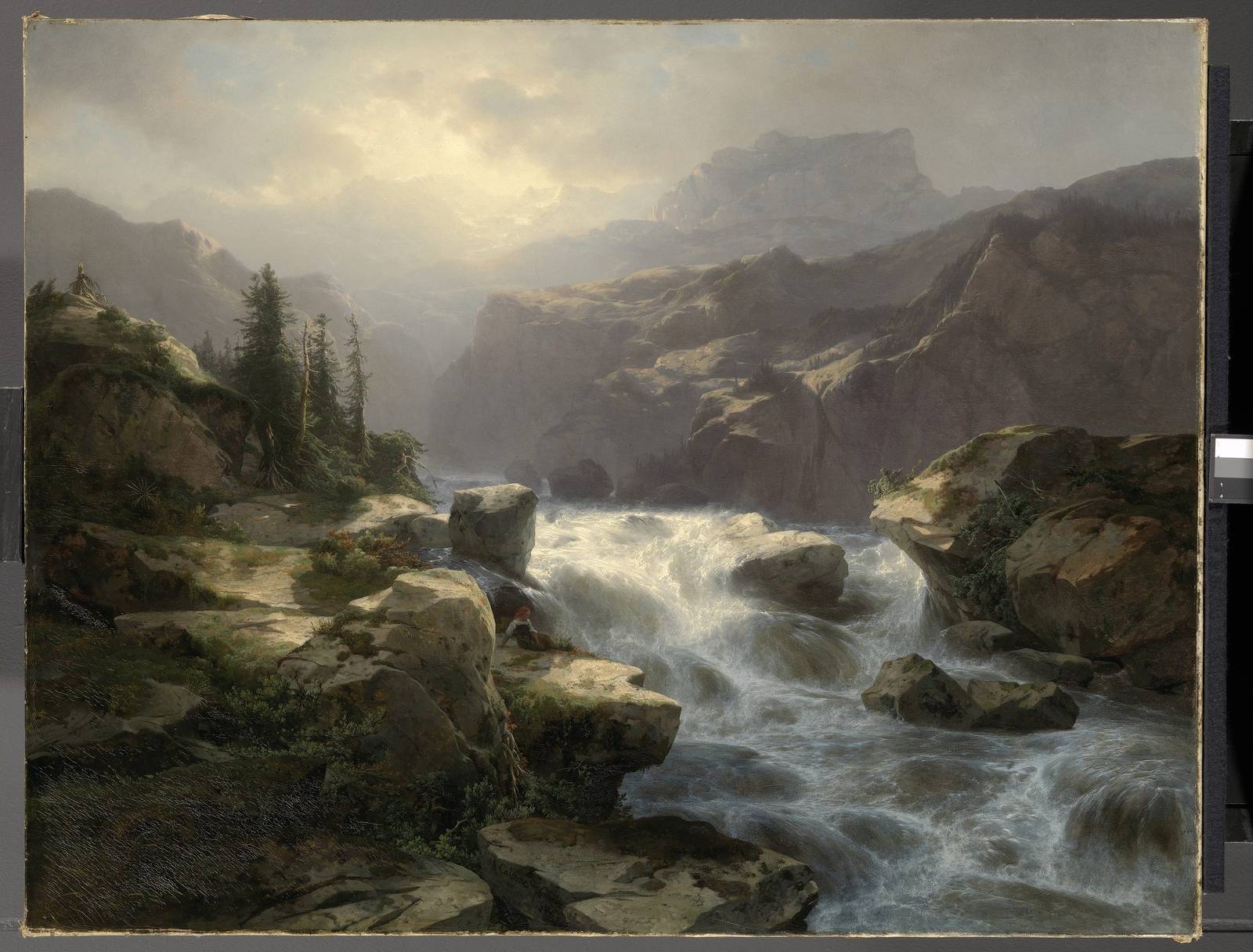
Calame’s Waterfall from Handeck toward Grimsel (c. 1839) shows the kind of scene he loved: white water tearing through a rocky gorge on the road up to the Grimsel Pass, under a dark, unsettled sky. Nothing here is tidy. Boulders, broken trees and spray crowd the foreground, and the effect is closer to weather than to scenery. Diday’s The Giessbach Falls on Lake Brienz is gentler: a chain of cascades stepping down through a steep pine forest above the lake, with goats picking their way across the rocks. His Alpine Waterfall is greener again, a stream pouring down a mountainside between rocks and pines. Together they show the two moods of the Alpine waterfall, the wild and the idyllic.
New England and the Hudson River School
American painters of the Hudson River School inherited the Romantic love of falling water, but they found their subjects close to home, in the Catskills, the Berkshires and the White Mountains of New Hampshire. Their waterfalls tend to be quieter and more intimate than the Alpine ones: a stream in a mossy glen, light filtering through the trees, a scale you could walk into.
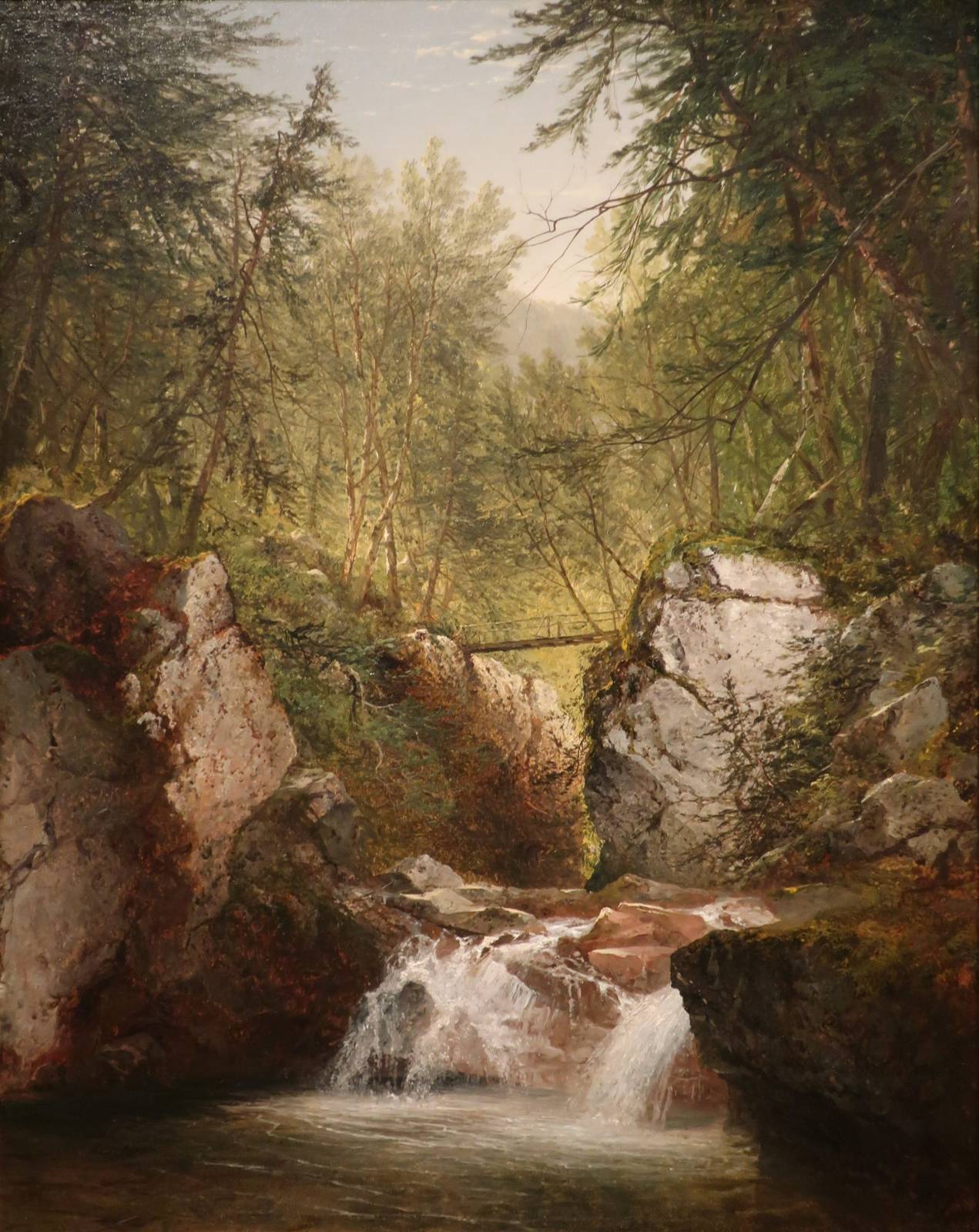
John Frederick Kensett’s Bash-Bish Falls (1855) is a fine example. Bash Bish Falls drops through a narrow gorge in the far southwest corner of Massachusetts, and Kensett, known for calm, carefully lit pictures, gives it a hushed, almost private feeling. James McDougal Hart, a Scottish-born painter who worked in New York, takes a similar approach in Waterfall in the Mountains (1859), where a slender fall slips past a mossy cliff in soft, misty light.
Albert Bierstadt is best known for the giant Western canvases, but he painted in New England too. His Glen Ellis Falls (1869) shows the waterfall in Pinkham Notch in New Hampshire’s White Mountains, pouring through a deep, green gorge. Pictures like these are a good choice if you want a waterfall that feels restful rather than dramatic, and they suit a bedroom, a reading corner or a study.
Niagara: the American icon
No waterfall meant more to nineteenth-century Americans than Niagara. It was a national symbol, a honeymoon destination and a test that every ambitious landscape painter seemed to take at some point. The most famous attempt is Frederic Edwin Church’s enormous Niagara of 1857, but many artists painted the falls on a far smaller scale.
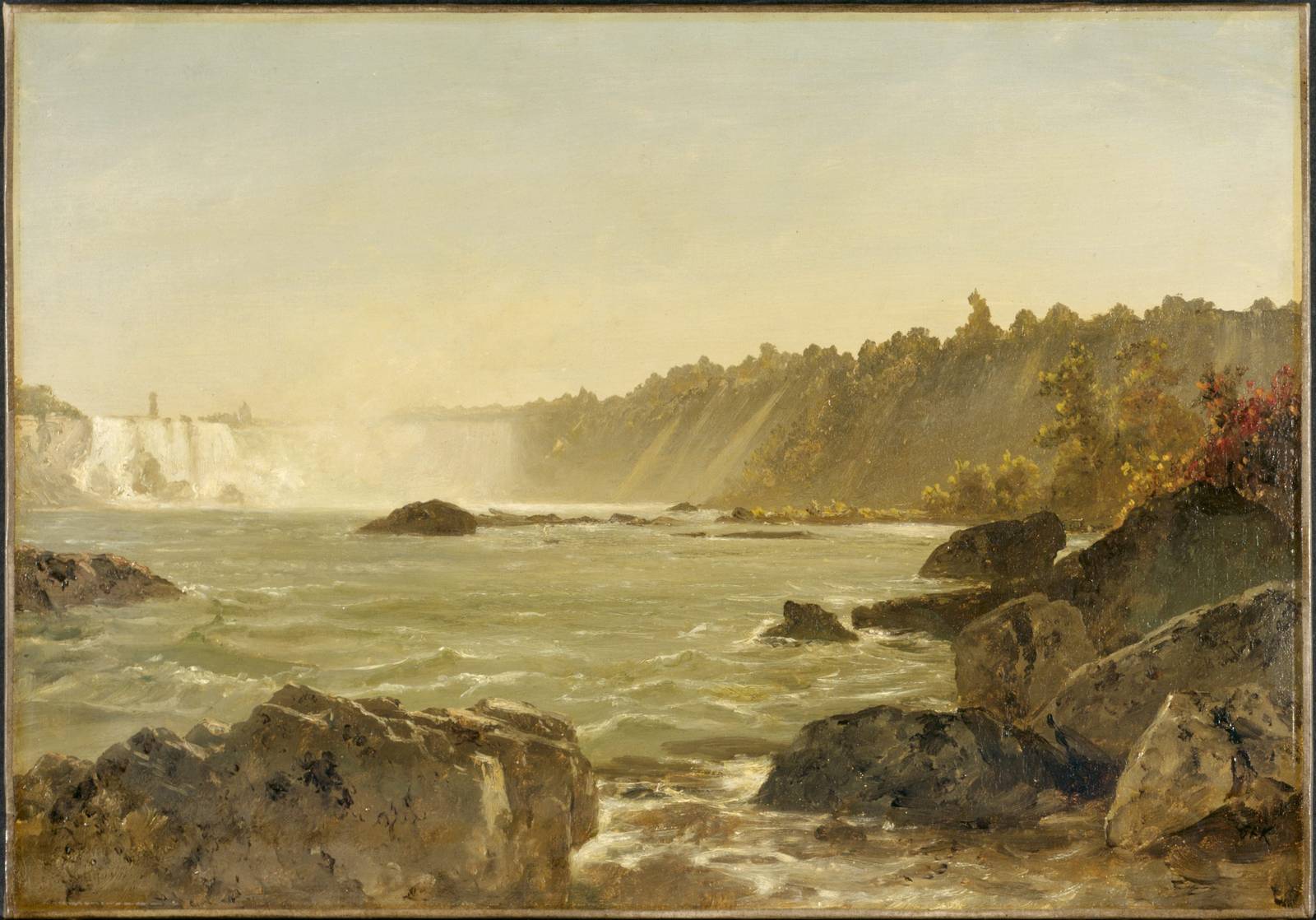
Kensett’s View of Niagara Falls, a small oil from around 1851–52 in the Cleveland Museum of Art, is a lovely counterweight to the grand spectacle. Instead of overwhelming us, he lets the falls spread across a broad, calm view, with mist rising into a pale sky. It is a picture about scale and distance, and it rewards a close look. For another view, see Thomas Cole’s distant view of Niagara.
Yosemite: waterfalls of the West
When painters and photographers reached Yosemite Valley in the 1850s and 1860s, they found waterfalls on a scale nothing in the East could match, dropping off granite walls thousands of feet high. Images of the valley helped build support for protecting it: in 1864 Congress granted Yosemite Valley to the state of California to be preserved for public use, an early step toward the national parks.
In Yosemite the waterfall became a measure of the whole continent: thin white threads hanging from walls of granite.
Bierstadt first visited Yosemite in 1863 and returned often. His Bridal Veil Falls, Yosemite Valley, California (1871–73) sets the famous fall behind oaks and golden grass on the valley floor, while Nevada Falls, Yosemite moves in close as the Merced River pours over a granite ledge into white spray. For the whole valley at once, there is his Looking Down Yosemite Valley, California (1865).
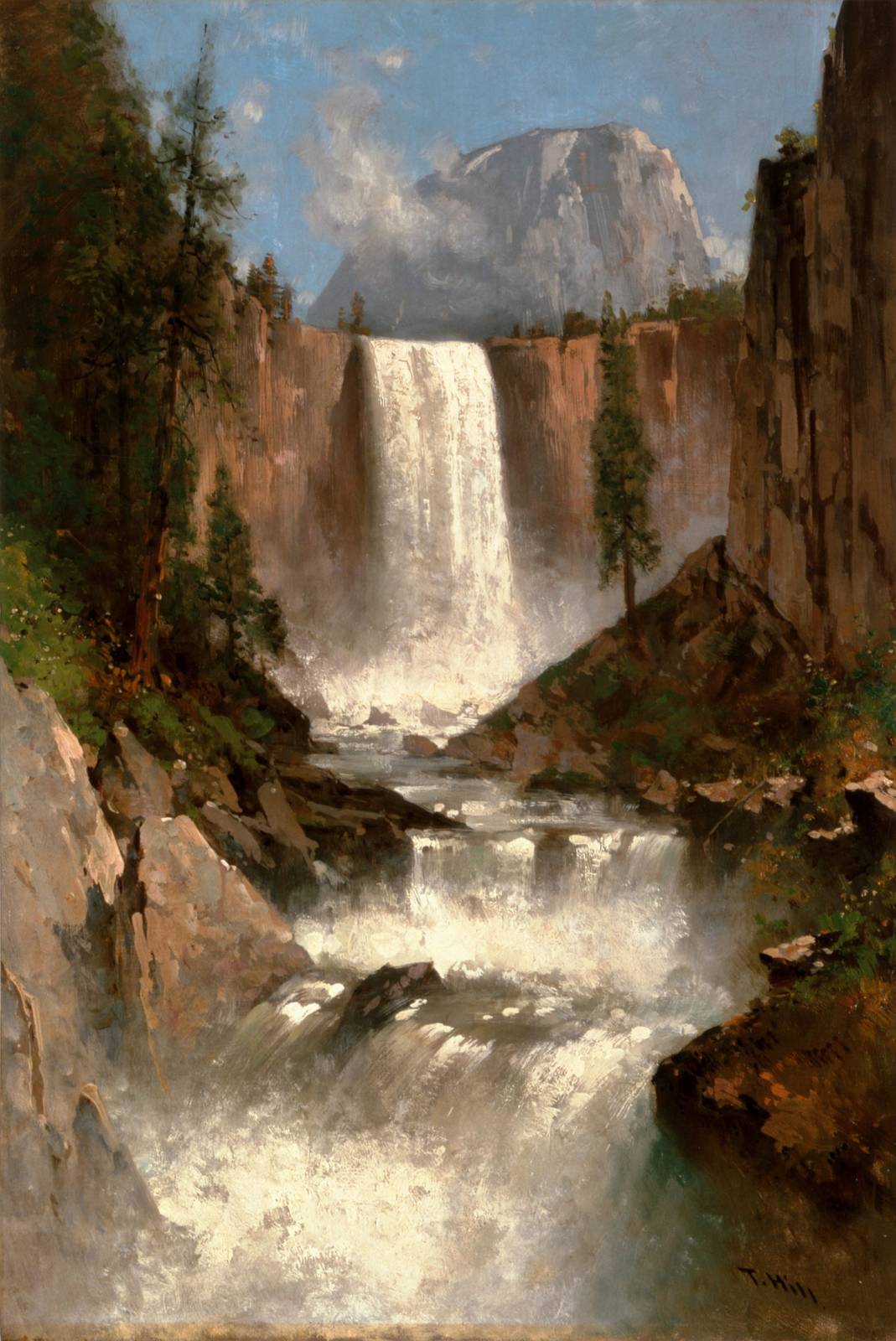
Thomas Hill, born in England and raised in the United States, made Yosemite his life’s subject and kept a studio at Wawona, near the park, for many years. His Vernal Falls, Yosemite (1889) is a tall picture of a cascade pouring between granite cliffs and dark pines, and his Yosemite, Bridal Veil Falls (1895) adds a small angler on the Merced, which gives the scene its scale. Both are in the White House collection. You can see more of the valley in our Yosemite paintings collection.
Yellowstone: color and canyon
Yellowstone became the first national park in 1872, and its canyon and falls drew painters for the rest of the century. Bierstadt’s Yellowstone Falls (1881), in the Buffalo Bill Center of the West, shows the Yellowstone River plunging into its canyon, with the warm yellows and oranges of the canyon walls that gave the place its fame. If you love this view, our guide to Thomas Moran’s Yellowstone paintings goes deeper.
How to choose a waterfall print
- Use the shape. Many waterfall paintings are vertical, which makes them ideal for narrow walls, hallways, stairways and the space beside a door. Thomas Hill’s Vernal Falls and Bierstadt’s Nevada Falls both work beautifully in tall spaces.
- Pick a mood. Calame’s storm-lit gorge brings energy to a living room or office; Kensett’s Bash-Bish Falls or Hart’s misty fall is calmer, better for a bedroom or reading corner.
- Think about the room’s colors. Most of these pictures are built on greens, grays and white water, which sit easily with natural wood, stone and neutral walls. Bierstadt’s Yellowstone Falls adds warm gold and ochre.
- Choose a size. Every work comes framed and ready to hang in up to three sizes, Small at $195, Medium at $295 and Large at $395, printed at the original’s true proportions without cropping. Exact dimensions are on each work page.
- Frame it simply. A black or natural wood frame suits the cooler Alpine and New England scenes; a gold frame flatters the warmer Western canvases.
For more, browse our waterfall paintings, mountain paintings and Hudson River School collections, or see every work by Albert Bierstadt and Thomas Hill.