
Few painters have a name that works the way Rembrandt’s does. Say it, and most people picture the same things: deep brown shadows, a face caught in warm light, a sense that the person in the painting is thinking something they have not said out loud. Rembrandt Harmensz. van Rijn worked in the Dutch Republic in the seventeenth century, a small, wealthy, argumentative country that bought paintings the way later generations bought furniture. Out of that market he made pictures that still feel private and alive.
This guide walks through the Rembrandt paintings in our Rembrandt collection roughly in the order he made them, from the ambitious young painter in Leiden to the old man in Amsterdam who kept painting his own face. Along the way are notes on what to look for in each picture and how to choose one for your wall.
Rembrandt made pictures that still feel private and alive.
Leiden: the young man in armor
Rembrandt was born in Leiden in 1606, the son of a miller. After a local apprenticeship he spent about six months in Amsterdam with the history painter Pieter Lastman, then came home and set up as an independent artist while still in his late teens, working closely with his friend Jan Lievens. The two young men pushed each other, and both used their own faces as free, always-available models.
His Self-Portrait with Breastplate dates from about 1629, when he was around twenty-three. He wears a steel gorget, the throat armor of a soldier, though he was no soldier: the costume is a painter’s prop, a way to practice how light slides over polished metal and to try on a more heroic version of himself. Half his face falls into shadow. The painting is now in the Germanisches Nationalmuseum in Nuremberg, and because it is a small panel we offer it in our smaller sizes, where it reads best.
Amsterdam fame: portraits and a storm
In the early 1630s Rembrandt moved to Amsterdam, then one of the richest cities in Europe, and worked with the art dealer Hendrick van Uylenburgh. In 1634 he married Uylenburgh’s cousin Saskia. Commissions poured in, beginning with The Anatomy Lesson of Dr. Nicolaes Tulp (1632, Mauritshuis, The Hague), and for a decade he was the most fashionable portrait painter in the city.
One small product of those years has an unusual claim to fame. The Portrait of Jacob de Gheyn III (1632), a quiet oil on panel of an engraver’s son, belongs to the Dulwich Picture Gallery in London. It is so small and so valuable that thieves took it four times between 1966 and 1983, earning it a reputation as one of the most frequently stolen paintings in the world. Each time, it came back.
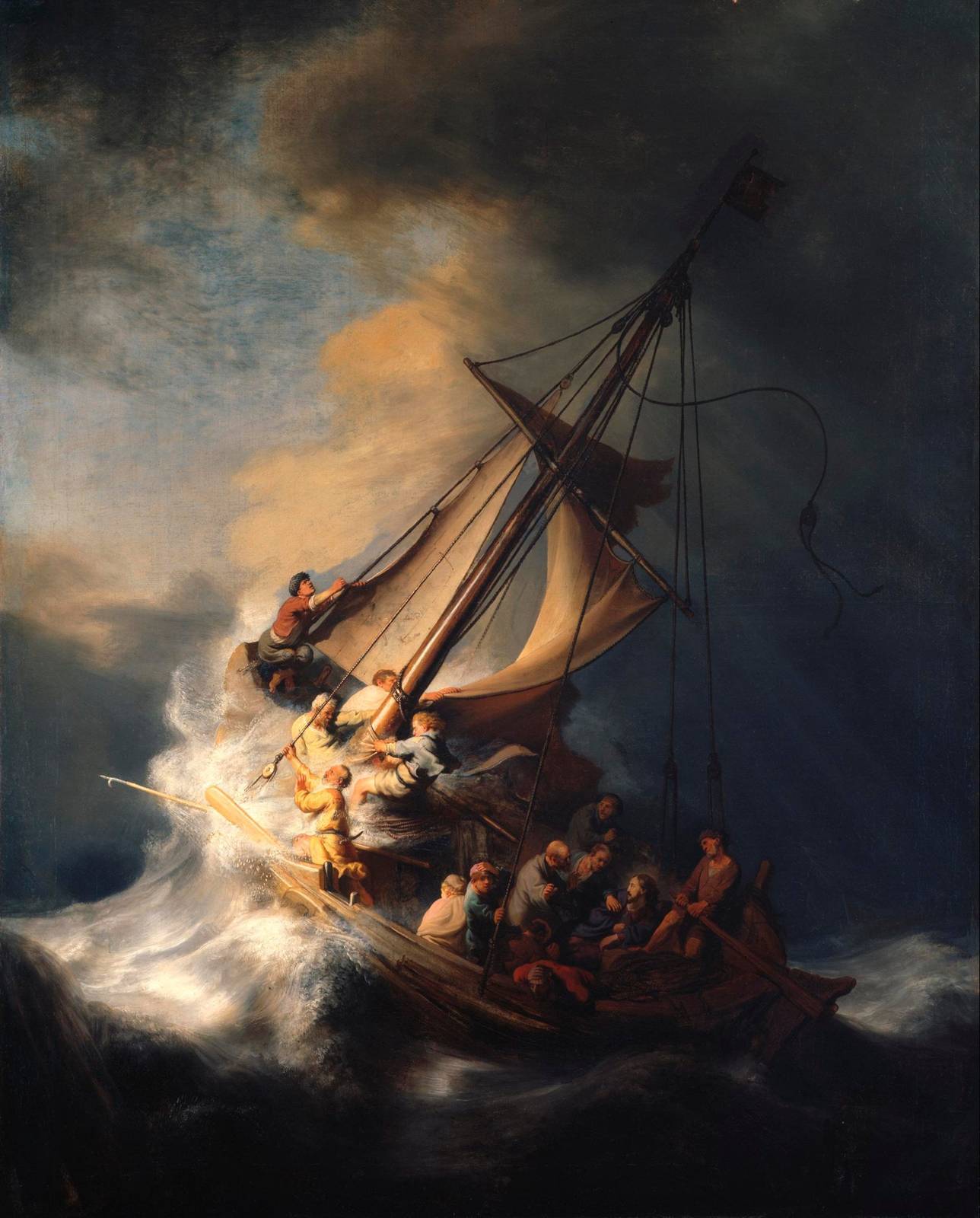
The Storm on the Sea of Galilee (1633) had worse luck. It is Rembrandt’s only seascape: Christ’s disciples fight to control a fishing boat as a wave lifts the bow and the sail tears, while Christ sits calmly in the shadowed stern. One figure looks straight out at us, and he is often thought to be the painter himself. The picture hung in the Isabella Stewart Gardner Museum in Boston until March 1990, when thieves disguised as police officers took it with twelve other works. It has never been recovered, and the museum still displays its empty frame. A print is, quite literally, the only way to hang it today.
The Night Watch
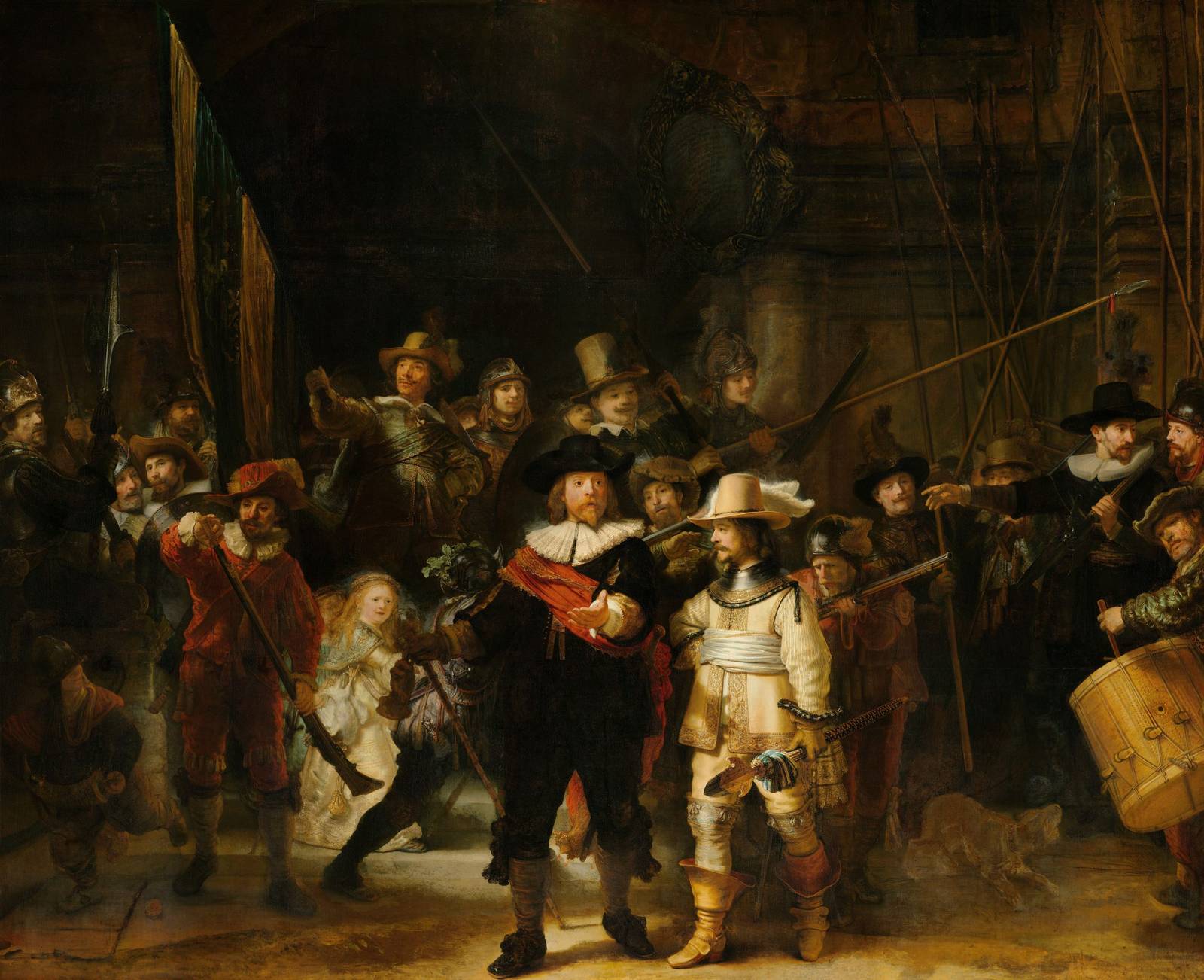
Rembrandt’s most famous painting was a group portrait, the standard commission for Dutch civic militias, which liked to be painted lined up in rows so that everyone who paid got an equal share of the canvas. The Night Watch (1642) throws that formula out. Captain Frans Banninck Cocq strides toward us, giving an order to his lieutenant, Willem van Ruytenburch, in pale gold; behind them men load muskets, raise a banner and beat a drum, and a small girl in gold, lit like a spotlight, carries a chicken whose claws were an emblem of the company.
Its popular name is a misunderstanding. The scene takes place in daylight; centuries of darkened varnish made it look like night, and the nickname stuck. The canvas was also trimmed on all sides in 1715 to fit a wall in Amsterdam’s Town Hall. Today it is the centerpiece of the Rijksmuseum, where a long public research and restoration project, Operation Night Watch, began in 2019.
A print is, quite literally, the only way to hang The Storm on the Sea of Galilee today.
The year of The Night Watch was also the year Saskia died, leaving Rembrandt with their infant son, Titus, the only one of their children to survive childhood. The decades that followed brought money troubles, and in 1656 he applied for a form of bankruptcy; his house and collection were sold. His companion Hendrickje Stoffels and Titus later ran an art business that employed him, protecting him from creditors.
The late work: rougher, warmer, deeper
As fashion moved toward smooth, bright painting, Rembrandt went the other way, laying on paint thickly and working it with brush, palette knife and even his fingers. The Polish Rider (about 1655), a young horseman crossing a dusky landscape, is one of the most haunting pictures of these years; scholars have debated its attribution and meaning for decades, and it now hangs in the Frick Collection in New York. Moses Smashing the Tablets of the Law (1659, Gemäldegalerie, Berlin) shows the prophet raising the stone tablets above his head at the moment before he breaks them.
The Conspiracy of Claudius Civilis (1661–62) was commissioned for Amsterdam’s new Town Hall and was originally the largest painting he ever made. It was returned to him after hanging only briefly, and he cut it down to the central scene, Batavian rebels swearing an oath by a glowing hidden light. The surviving fragment is in the Nationalmuseum in Stockholm.
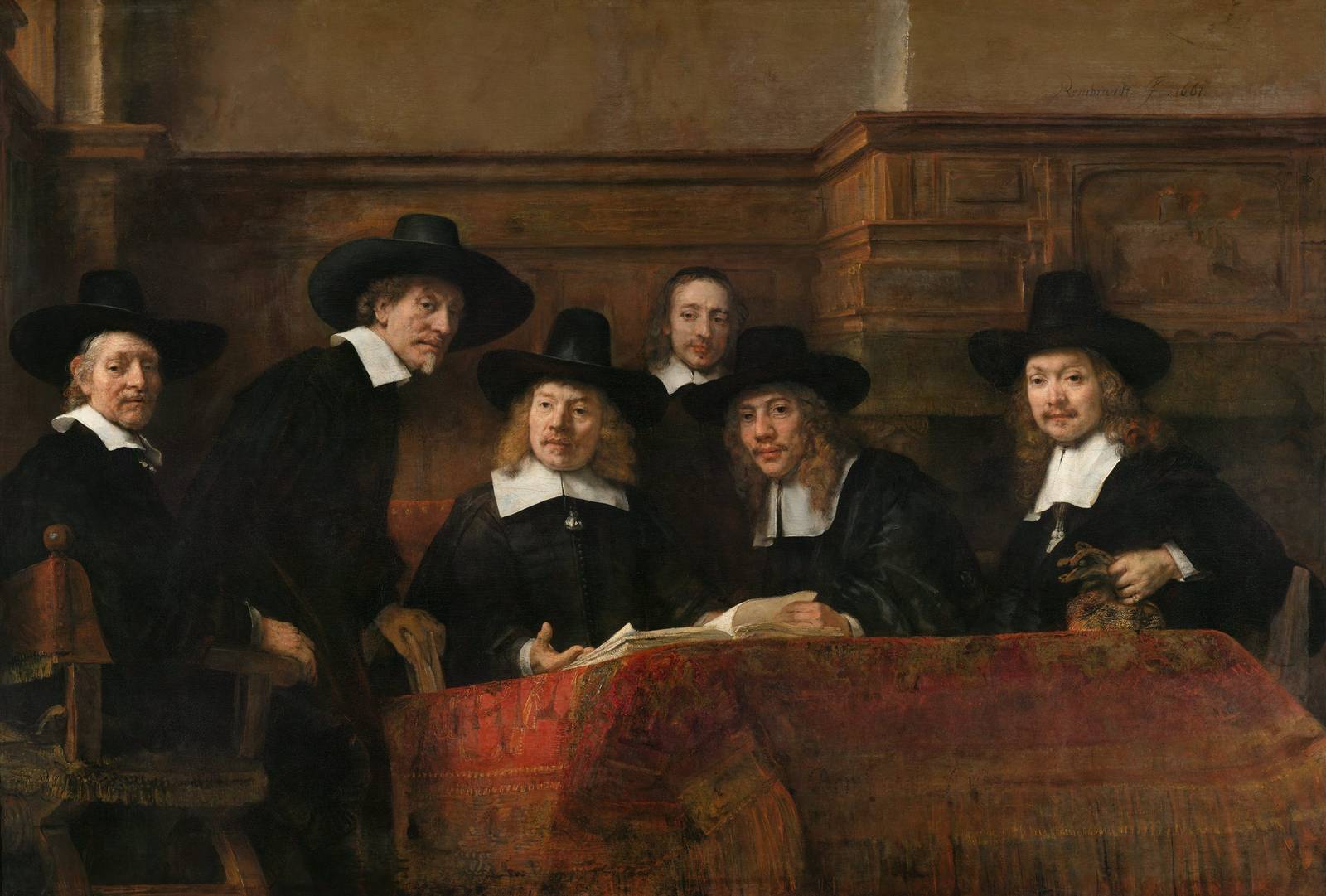
A year later came Syndics of the Drapers’ Guild (1662), five officials who inspected the quality of dyed cloth, with their servant standing bareheaded behind them. They look up from their sample book as if we had just walked in. It became so familiar that it was long used on Dutch Masters cigar boxes, and it remains a natural choice for an office or a study.
The self-portraits
Across his career Rembrandt painted around forty self-portraits, plus many more etchings and drawings of his own face: more than almost any artist before the modern era. In Self-Portrait as the Apostle Paul (1661, Rijksmuseum) he holds Paul’s manuscript, with the hilt of the saint’s sword tucked into his cloak, and raises his eyebrows at us with weary humor.
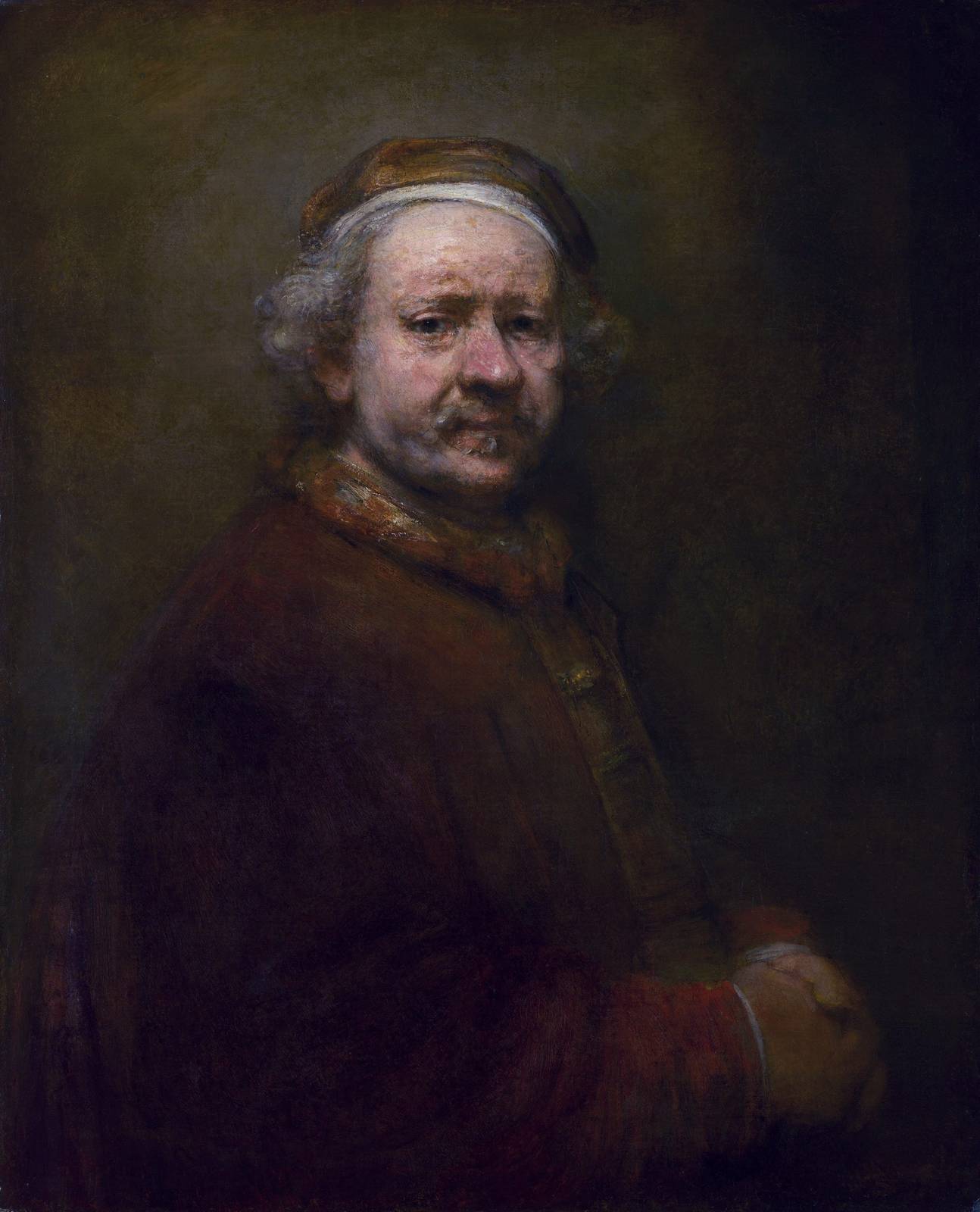
The Self-Portrait at the Age of 63 is one of his last. He painted it in 1669, after Hendrickje’s death in 1663 and Titus’s in 1668, and he died in Amsterdam that October. His hands are clasped, his face lit softly against the dark, and there is no flattery and no self-pity in it. It is one of the most honest paintings of old age ever made, and it hangs in the National Gallery in London.
Choosing and framing a Rembrandt print
- Match the picture to the room. The Night Watch and The Storm on the Sea of Galilee are big, dramatic scenes for a living room or a long hallway. The self-portraits and the de Gheyn portrait are intimate, best in a study, library or bedroom where you see them up close.
- Go dark or go gold. Rembrandt’s warm browns and golds look rich in a gold or walnut frame; a black frame sharpens the contrast between light and shadow and suits a modern room.
- Give the light some light. These paintings are mostly dark, so hang them where daylight or a picture lamp can reach them, and avoid a spot opposite a bright window, where glare can wash out the shadows.
- Size it. Every work comes framed and ready to hang in up to three sizes, Small at $195, Medium at $295 and Large at $395, printed at the painting’s true proportions without cropping. Exact dimensions are on each work page.
For more Dutch painting, browse our Dutch Golden Age marine paintings, or see every work on our Rembrandt van Rijn page and the wider Masterpieces collection.