
Impressionism is usually told as a story of men in straw hats painting riverbanks: Monet, Renoir, Degas, Pissarro. But two of the movement’s finest painters were women, and they looked at the world from a different place. Mary Cassatt, an American in Paris, and Berthe Morisot, a Parisian born into the upper middle class, painted the lives they knew from the inside: tea in the drawing room, an evening at the opera, a child at a mother’s knee, a summer afternoon on the lake.
This guide introduces both artists through the paintings in our collection, with a little history and some ideas for hanging them at home. You can browse everything by Mary Cassatt and Berthe Morisot on their artist pages.
They painted the lives they knew from the inside, and that made their pictures feel close and unposed.
Mary Cassatt: an American in Paris
Mary Cassatt was born in 1844 in Allegheny City, now part of Pittsburgh, Pennsylvania. She studied at the Pennsylvania Academy of the Fine Arts and then went to Europe, settling in Paris in the 1870s, where she spent most of the rest of her life. Edgar Degas admired her work and invited her to exhibit with the Impressionists, and she showed with the group for the first time in 1879. She was the only American to exhibit with them.
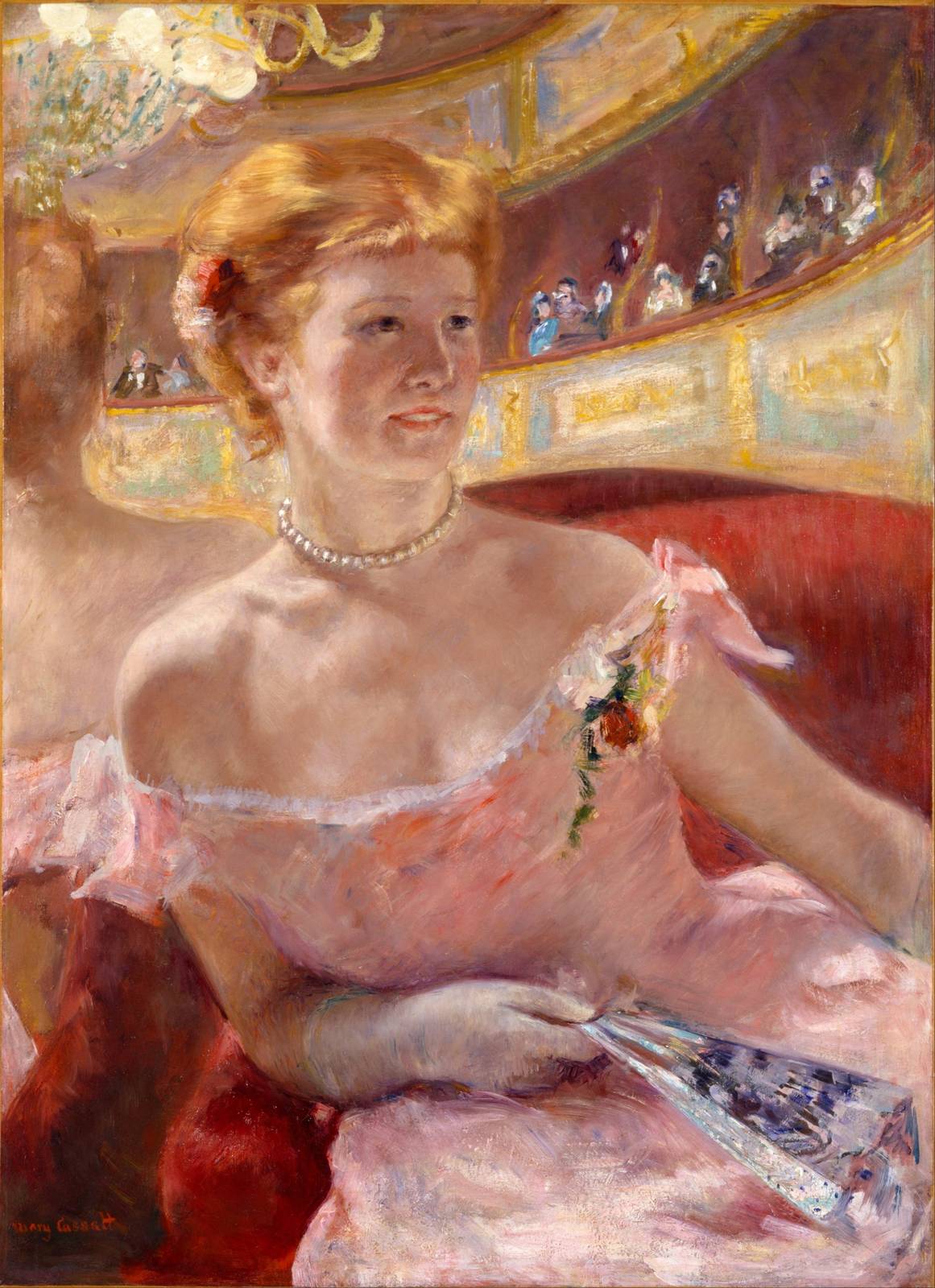
Her Woman with a Pearl Necklace in a Loge (1879, Philadelphia Museum of Art) is one of the pictures that announced her arrival. The model is her sister Lydia, seated in a box at the Paris Opéra in a pink gown, with the mirror behind her full of reflected light, chandeliers and balconies. Theater boxes were a favorite modern subject, a place to see and be seen, and Cassatt treats this one with quick, bright brushwork that is pure Impressionism.
Lydia, who had come to live with Mary in Paris, appears again in The Cup of Tea (c. 1880, The Metropolitan Museum of Art). She sits in an armchair in a pink dress, holding a cup and saucer, absorbed in her own thoughts. It is a small, ordinary moment, and Cassatt makes it feel private and modern at once. Lydia died in 1882, which gives these pictures of her an added tenderness.
Mothers and children
Cassatt is best known today for paintings of mothers and children, a theme she returned to again and again from the 1880s on. She avoided sentimentality: her children fidget, lean and slump, and her mothers are busy with their own tasks.
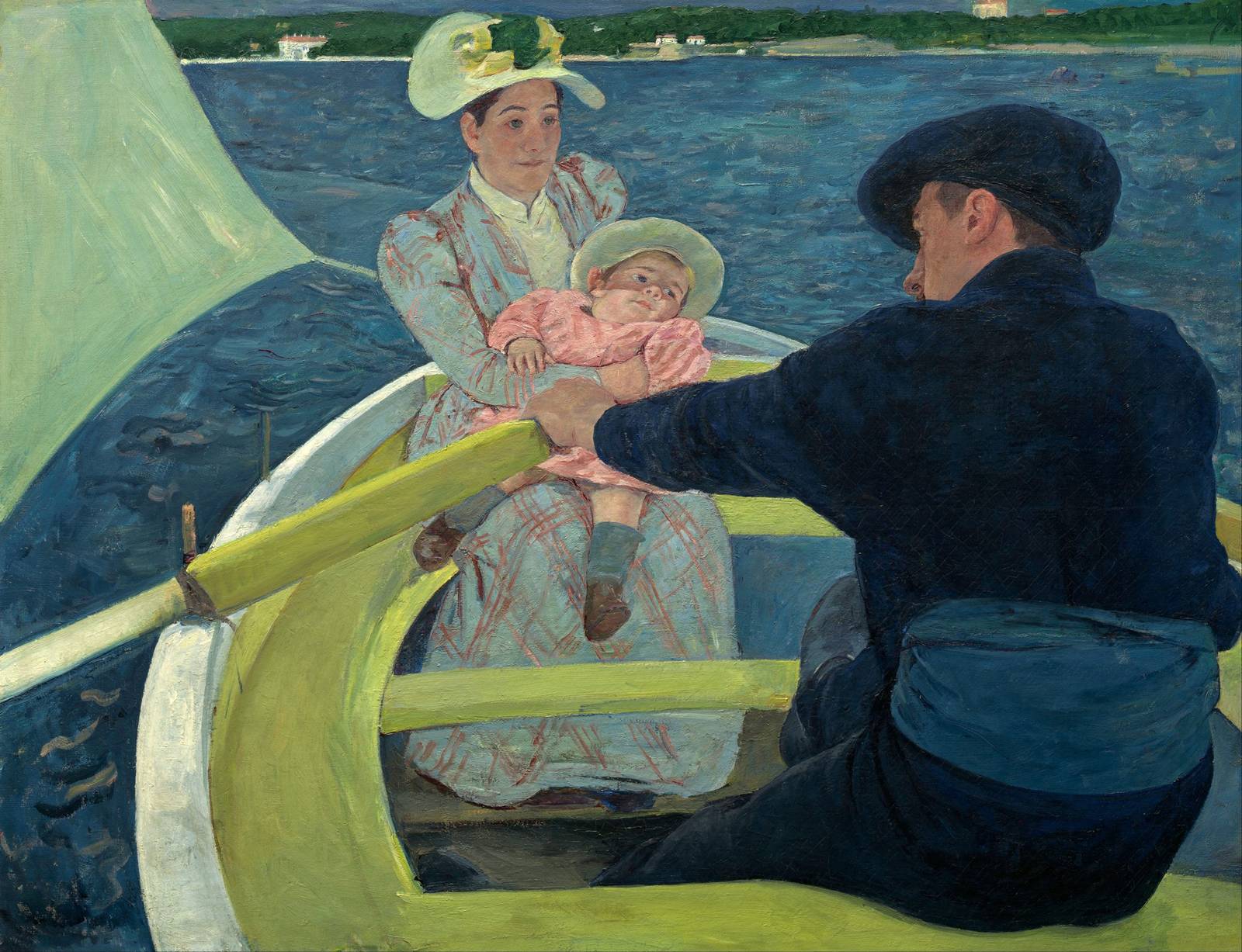
The Boating Party (1893–94, National Gallery of Art) was painted at Antibes on the Mediterranean. A mother holds a child on her lap while a boatman in dark clothes pulls on the oars, and the yellow sail and bright blue water make big, flat shapes. The bold design reflects Cassatt’s interest in Japanese woodblock prints, which she had seen in a large exhibition in Paris in 1890. It is one of her most striking pictures, and it reads well from across a room.
Young Mother Sewing (1900, The Metropolitan Museum of Art) is quieter: a little girl leans on her mother’s knee by a sunny window while the mother works on her sewing. The painting came to the Met from the collection of Louisine Havemeyer, Cassatt’s lifelong friend, whom she advised on buying Impressionist art. In 1915 Havemeyer organized an exhibition of works by Cassatt and Degas in New York to raise money for the women’s suffrage campaign.
Berthe Morisot: a founder of Impressionism
Berthe Morisot was born in 1841 in Bourges and grew up in Paris. She trained as a painter from her teens and was a founding member of the Impressionist group, showing at their first exhibition in 1874 and in all but one of the eight that followed. In 1874 she married Eugène Manet, the brother of the painter Édouard Manet, and their daughter Julie became one of her favorite models.
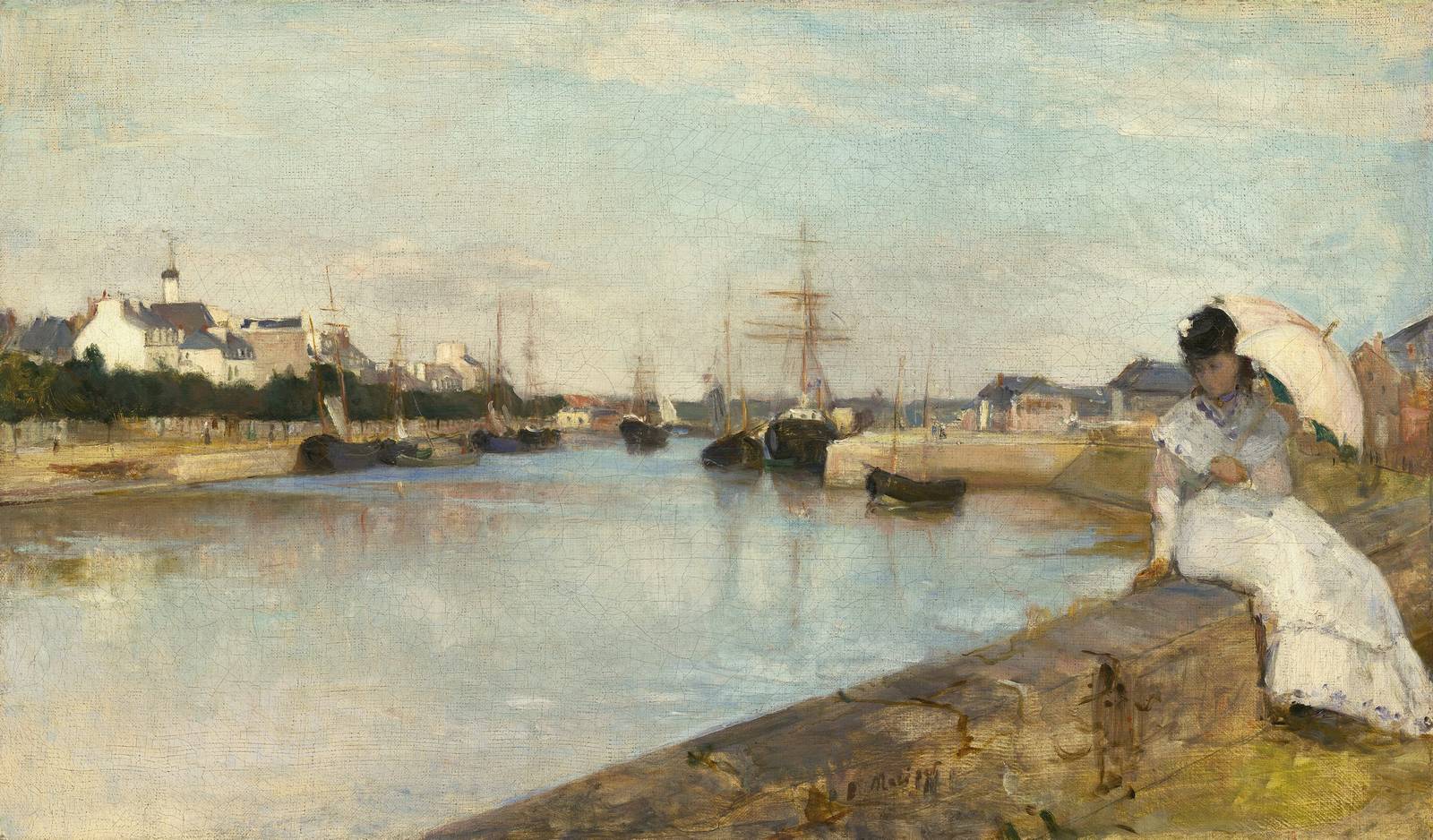
The Harbor at Lorient (1869, National Gallery of Art) is an early masterpiece, painted in Brittany several years before the first Impressionist exhibition. A young woman with a parasol sits on a harbor wall while the water spreads out pale and still under a summer sky. The color is light and silvery, and the brushwork is already loose and confident. Morisot gave the painting to Édouard Manet.
Her Summer’s Day (1879, The National Gallery, London) shows two fashionable women in a rowboat on the lake in the Bois de Boulogne, the great park on the western edge of Paris. The brushstrokes are so quick and open that the water, the dresses and the ducks almost dissolve into flickers of light. In a Park (c. 1874, Petit Palais, Paris), a pastel, is softer: a young woman in black sits in long grass with a child and a dog.
Morisot’s brushstrokes are so quick that water, dresses and sunlight almost dissolve into one another.
Cassatt and Morisot side by side
The two painters knew and admired each other, and their work makes an unusually good pairing. Cassatt is the stronger draftsman, with firm outlines and clear shapes; Morisot is the freer painter, with a feathery touch and silvery light. Both chose subjects that their male colleagues rarely painted from the inside: the drawing room, the nursery, a mother and child, women’s friendships and leisure. A Cassatt and a Morisot hung together tell that story well.
Hanging Cassatt and Morisot at home
- For a nursery or child’s room. The Boating Party and Young Mother Sewing are warm without being sugary, and they will still look right when the child is grown.
- For a bedroom or dressing room. Woman with a Pearl Necklace in a Loge and The Cup of Tea bring soft pinks and golds that sit well with light walls and brass or gold frames.
- For a living room. Summer’s Day and The Harbor at Lorient are calm, airy pictures that open up a wall; a white or natural wood frame keeps them light.
- As a gift. These paintings make a thoughtful present for a new mother, a sister or a friend who loves Paris.
- Choose a size. Every work comes framed and ready to hang in up to three sizes, Small at $195, Medium at $295 and Large at $395, printed at the original’s true proportions without cropping. Exact dimensions are on each work page.
For more from the movement, browse our Impressionist paintings collection, or see works by Edgar Degas, Claude Monet and Édouard Manet.