
Botanical prints are among the easiest pieces of art to live with. They are calm, precise and endlessly varied, and they look as at home in a modern kitchen as in a paneled library. The best of them were made not as decoration at all but as science: careful records of plants, many newly arrived in Europe, drawn by artists who worked alongside botanists. This guide introduces the great names behind the antique botanical prints in our collection, explains what makes each style different, and offers practical advice on choosing sizes and frames.
Why botanical art looks the way it does
Before photography, the only way to share an accurate picture of a plant was to draw it, engrave the drawing on a metal plate and print it. Scientific illustrators were expected to show a species clearly enough that a reader could recognize it: the shape of the leaves, the structure of the flower, sometimes the seed or root as well. That is why classic botanical prints place a single plant against a plain background, often with details arranged around it. The discipline of the science is what gives the images their elegance.
Many prints were colored by hand, sheet by sheet, after printing. Others used techniques that applied color to the plate itself. Either way, the antique originals were costly and produced in limited numbers, which is part of why fine botanical books are prized by collectors today.
Georg Dionysius Ehret, the botanist’s artist
Georg Dionysius Ehret (1708–1770) was born in Germany, trained as a gardener and settled in England, where he became one of the most admired botanical artists of the eighteenth century. He worked in close contact with the leading botanists of his day, including Carl Linnaeus, whose system of classifying plants by their reproductive parts was transforming the field. Ehret’s drawings are known for their accuracy and for the poise of their compositions.
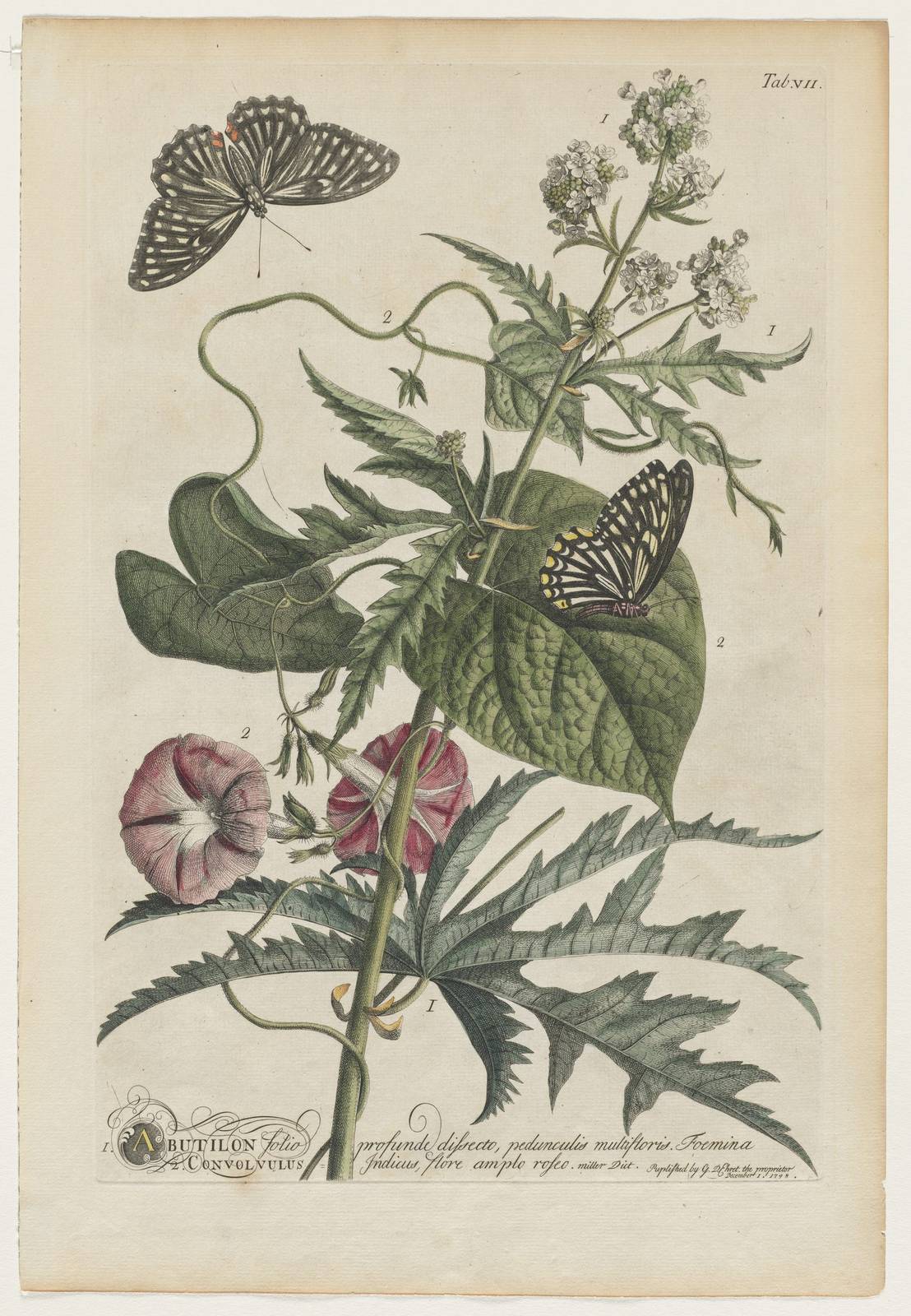
Many of his drawings were engraved for Plantae Selectae, a grand illustrated work published in Nuremberg by the physician Christoph Jacob Trew between 1750 and 1773. Pulmonaria, Plate 42 and Lilio-Gladiolus, Plate 39 both come from that work. Ehret also produced his own set, Plantae et Papiliones Rariores, which paired rare plants with butterflies; Plate 7 (1748) shows how lively a page could be when the two were combined.
The discipline of the science is what gives the images their elegance.
Maria Sibylla Merian and the living plant
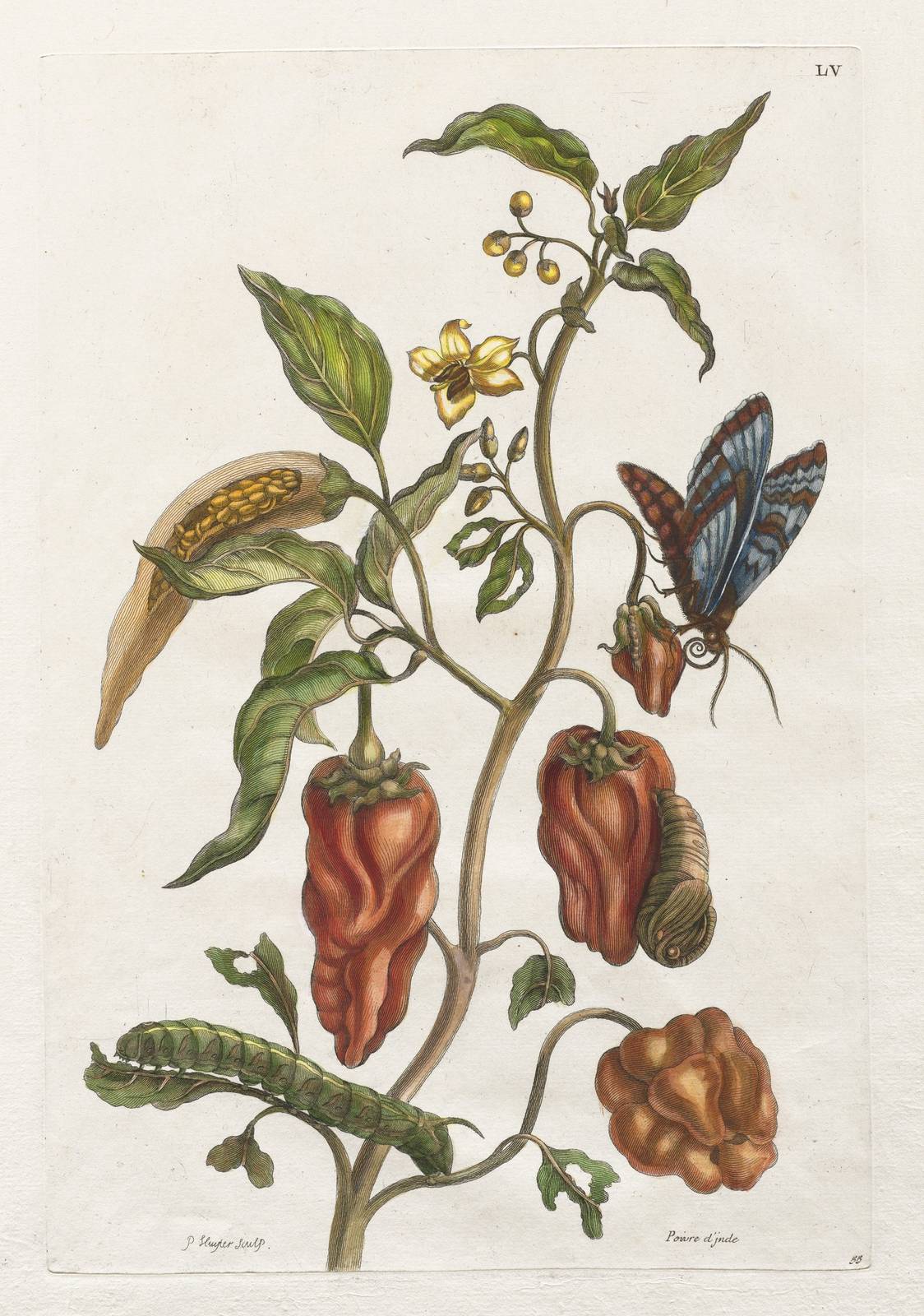
Maria Sibylla Merian (1647–1717) took botanical art in a different direction. Born in Frankfurt, she studied insects and their transformations at a time when the idea that insects arose spontaneously was still widely held. In 1699 she traveled to the Dutch colony of Suriname in South America with her daughter to study its plants and insects firsthand, and in 1705 she published Metamorphosis insectorum Surinamensium. Her plates show caterpillars, chrysalises and butterflies on the very plants they feed on, a striking mix of science and drama.
Her work remained popular long after her death and was reissued in later editions. Poivre d’inde, from Histoire générale des insectes de Surinam (1771) comes from one of those later French editions. It is a wonderful choice for anyone who wants a botanical print with a little more life and motion.
The Temple of Flora: botany as theater
At the turn of the nineteenth century, the English physician Robert John Thornton set out to publish the most spectacular flower book ever made. His Temple of Flora placed exotic flowers in front of dramatic, painted landscapes, with stormy skies and distant mountains, and hired several painters and engravers to realize it. The project was a financial disaster for Thornton, but the plates are now among the most celebrated flower prints of their era.
The Queen Flower, painted by Philip Reinagle, shows the bird-of-paradise flower blazing orange and blue against a dark landscape. White Lily with Variegated Leaves, engraved by Joseph Constantine Stadler, is quieter and more elegant. These are the boldest botanical prints in our collection, and they hold their own on a large wall.
Pierre-Joseph Redouté, the master of the rose
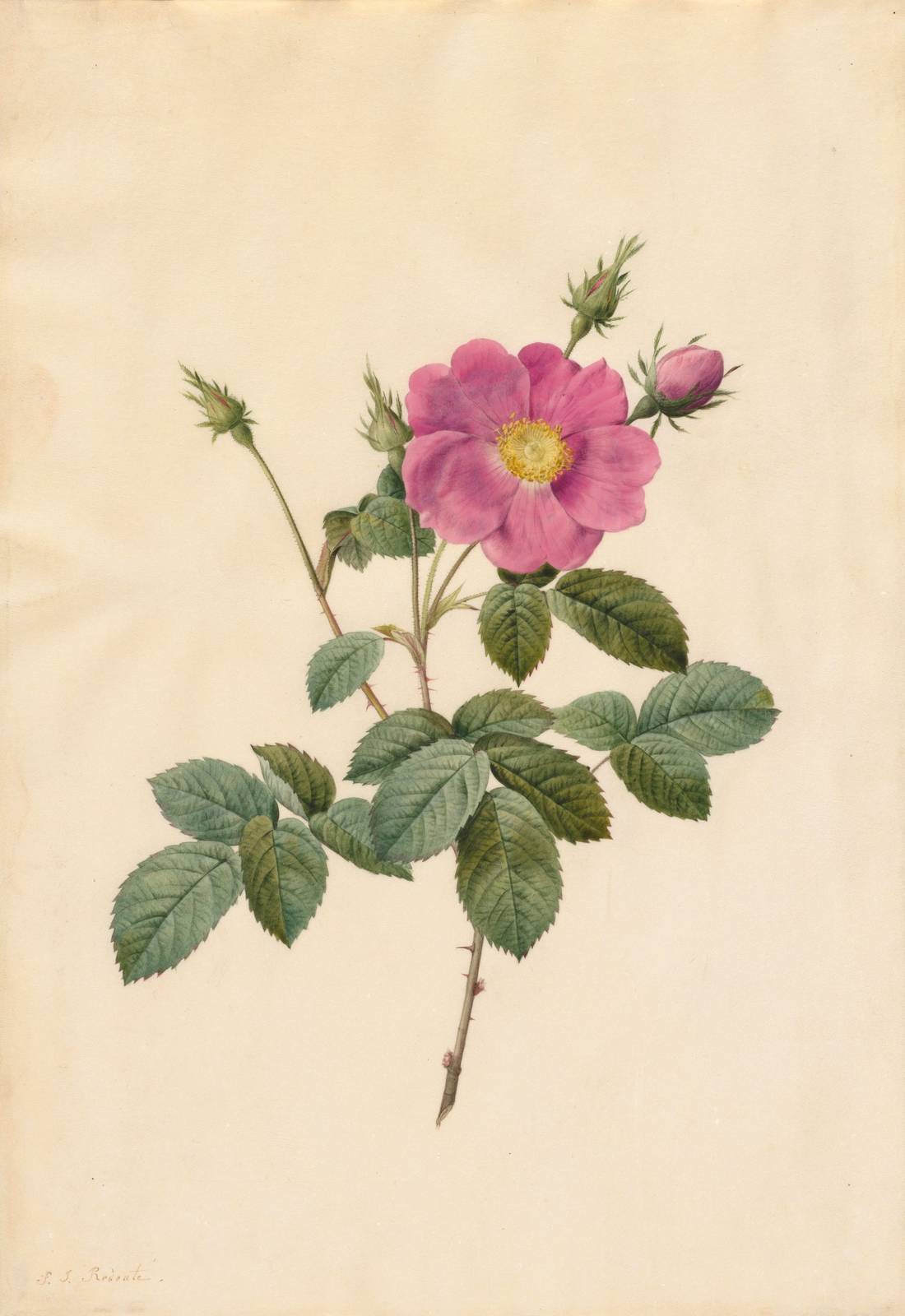
No name is more closely tied to flower painting than Pierre-Joseph Redouté (1759–1840). Born in the Ardennes, in what is now Belgium, he made his career in Paris and enjoyed royal and imperial patronage, including that of the Empress Joséphine, whose garden at Malmaison held one of the great rose collections of the age. His masterpiece, Les Roses, was published in parts between 1817 and 1824.
Redouté’s plates were made by stipple engraving, building tone from fine dots, then printed in color and finished by hand. The result is unusually soft and luminous. Cabbage Rose (Rosa Centifolia Simplex) and Brier Bush Rose or Dog Rose (Rosa Leucantha) both come from Les Roses, and they are among the most graceful flower prints you can hang.
A row of three matching botanicals is one of the simplest ways to make a room look deliberately designed.
Where botanical prints work best
- Kitchen and dining room: Ehret’s plants and Redouté’s roses bring a fresh, garden feeling to walls near the table.
- Bedroom: soft pink roses and pale lilies are restful and pair well with linen and light wood.
- Hallway or stairwell: a row of three matching botanicals is one of the simplest ways to make a room look deliberately designed.
- Living room or office: the dark, theatrical Temple of Flora plates have enough presence to stand alone.
Sizes, frames and grouping
Botanical prints are tall by nature, and every FrameAnyPhoto print keeps the original proportions with nothing cropped. Most of these works come in three sizes: Small at $195, Medium at $295 and Large at $395. The Redouté roses, for example, run from about 14 × 20 inches to 25 × 36 inches. For a set of three, Small or Medium in matching frames keeps the group crisp; for a single statement piece, choose Large.
The black metallic frame turns an antique botanical into something graphic and modern, especially in a set. The ornate wood frame suits the eighteenth-century character of Ehret and Merian and looks at home in traditional rooms. When grouping, keep spacing even, about two to three inches between frames, and hang the center of the group near eye level.
See every work in our botanical collection, on the Pierre-Joseph Redouté and Georg Dionysius Ehret artist pages, and among our flower paintings.